Noticed tiny, moth-like flies around your bathroom sink or shower drain? They may be drain flies. These insects breed in damp organic buildup, so swatting the adults won’t remove the source.
To get rid of drain flies in your bathroom, check the insects and look for the damp material where they’re breeding. Remove reachable buildup using the fixture’s care instructions, clear trapped debris and investigate persistent moisture. Flies near a drain are a clue, but don’t prove that it is the source.
The checks below will help you decide what you can clean yourself and when a plumber or pest-control professional needs to investigate.
Are these likely to be drain flies?
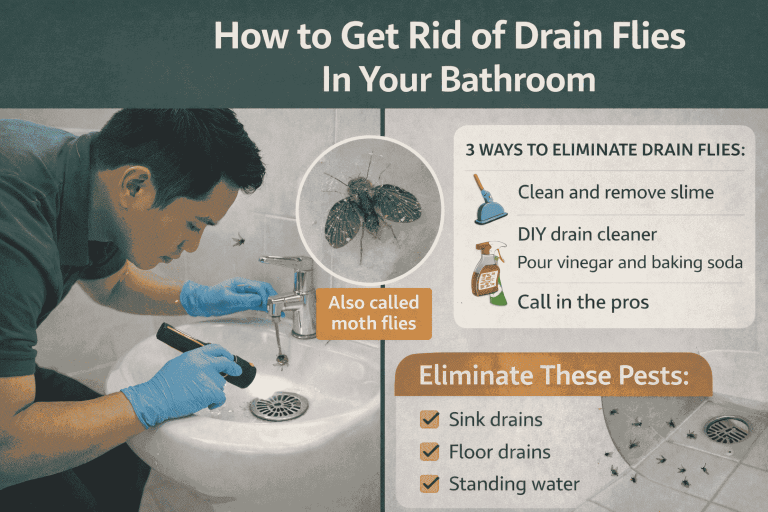
Drain flies, also called moth flies, have a fuzzy appearance and broad wings held like a small roof. You may notice them resting near a sink, shower or toilet.
University of Minnesota Extension describes their appearance and the damp organic film where their larvae can develop.
Location alone doesn’t identify a fly. Small insects around food, plant pots or a bathroom can have different sources. If yours don’t match the description, get identification before choosing a treatment.
| Your observation | What it suggests | What it doesn’t prove |
| Fuzzy, moth-like flies resting near a drain | Drain flies are a possibility | That this particular drain is the breeding source |
| Flies mostly near food or rubbish | Check food waste and bins as possible sources | That a drain-cleaning recipe will help |
| Flies mainly around plant pots | Check the insect and damp growing medium | That these are drain flies |
| Flies remain after accessible sources are cleaned | A source may be hidden or identification may be wrong | That you need stronger chemicals |
Find where the flies are breeding
Check the sink outlet, shower or floor drain, and nearby areas that stay damp. Look for accessible deposits and trapped debris. Don’t dismantle plumbing to investigate.
For an idle suspected drain, an adhesive-tape check can help. University of Minnesota Extension describes placing tape sticky side down over the opening to see whether emerging flies collect on it.
Before starting, check that the cover permits ordinary user access. Have a dedicated suitable brush ready, put on suitable gloves, and move toiletries out of the way. Protect the immediate area from splashes.
- Remove the cover only as permitted. Clear reachable loose debris without reaching blindly into the opening.
- Use the dedicated brush to remove accessible organic film. Keep splashes contained.
- Follow the fixture’s cleaning instructions, clean the surrounding area, and wash your hands afterwards.
Keep the drain brush separate from food-contact items. Penn State Extension’s moth-fly guidance explains why removing the breeding deposits matters.
If a product is needed, choose a labelled product suitable for the fixture and the intended job. Follow its instructions; don’t combine it with another cleaner or improvise a mixture.
If the wider bathroom clean is more than you want to handle yourself, Helpling’s home-cleaning service offers regular and one-time bookings. Check the bathroom checklist and discuss the accessible areas you need cleaned. Plumbing work and pest treatment need their own assessment.
What about boiling water, bleach or vinegar?
Pouring a household remedy down the drain is unlikely to solve the problem. University of Minnesota Extension describes hot or boiling water, bleach and chemical drain-cleaner pours as ineffective drain-fly control.
A pour may leave breeding material behind. Killing or trapping visible adults doesn’t show that the source has been removed either.
Skip the boiling-water and mixed-chemical recipes. They add unnecessary handling risks and can conflict with the fixture’s care instructions. Choose source removal and labelled, compatible treatment where appropriate.
Keep an eye on what changes
After cleaning, record which area you treated and where you continue to see flies. Check whether a damp patch, slow drain or leak remains.
If flies keep appearing, check for a source you’ve missed before adding another product.
Repeat the identification and source checks. A second drain, trapped wet debris or a hidden plumbing problem may need attention.
When do you need a plumber or pest-control assessment?
Arrange help when you can’t identify the insects, can’t reach a suspected source safely, or the flies persist after appropriate accessible cleaning.
A continuing leak, drainage problem or suspected hidden sewage source calls for plumbing investigation. University of Minnesota Extension notes that a broken sewer line can sometimes be involved.
Describe the observations rather than claiming a cause: where the flies appear, which drains you’ve checked, what you cleaned, and whether you noticed a leak or slow drainage.
You can bring a drainage or leak concern to Helpling’s plumbing service. Describe the fixture and problem when requesting a quote so the proposed work matches what needs checking.
For an HDB flat or condo, follow the appropriate building-management route if the suspected source sits outside the areas you control. Don’t open communal drainage components yourself.
Help prevent the buildup from returning
Keep reachable drain covers and surrounding surfaces clean using their care instructions. Remove trapped debris before it accumulates, and investigate persistent moisture rather than masking it with fragrance.
Regular bathroom upkeep and pest treatment are different tasks. You can check Helpling’s home-cleaning options for confirmed bathroom-cleaning scope, but don’t assume a booking includes pest control or plumbing work.
Our bathroom-cleaning guide covers the surrounding routine cleaning. Keep that upkeep separate from finding a hidden breeding source.
Common questions
How do I get rid of drain flies in the toilet?
First check the insects and the nearby breeding source. Flies resting near the toilet don’t prove that the toilet itself is the source. Check accessible floor drains and damp areas too.
Why do drain flies keep coming back?
The breeding material may remain, another source may be present, or the insect may have been misidentified. Source checks are more useful than repeating an adult-fly trap alone.
Will a vinegar trap solve the problem?
A trap may catch adult flies, but it won’t remove the damp organic buildup where larvae develop. Finding and cleaning that source is the step that matters.
Can home cleaning guarantee that the flies won’t return?
No. Cleaning can remove an accessible breeding source, but hidden drainage faults or another source may need separate attention.
Need help with bathroom cleaning or a blocked drain?
Choose the help that fits what you’ve found. For routine bathroom upkeep, check Helpling’s home-cleaning checklist and select a regular or one-time booking.
For a slow drain, leak or another plumbing concern, request a quote through Helpling’s plumbing service. Share the affected fixture, the source checks you’ve made and any continuing dampness.
If you’re still unsure what the insects are or where they breed, seek pest identification too. Book with Helpling for the cleaning or plumbing work that matches your problem.