

Cleaning your house on a consistent schedule prevents dust, bacteria, and grime from accumulating to the point where a single session cannot recover a healthy baseline. The right cleaning frequency depends on which room you are in, what surfaces are present, how many people and pets live in the home, and whether anyone in the household has allergies or respiratory conditions. Too little cleaning lets pathogens and allergens build up; too much cleaning wastes time, money, and can even damage surfaces through unnecessary chemical exposure.
This guide covers what a good home cleaning schedule looks like and how cleaning frequencies are classified, a room-by-room breakdown for kitchens, bathrooms, bedrooms, living areas, and floors, a side-by-side comparison of weekly vs fortnightly vs monthly cleaning, how deep cleaning differs from regular cleaning and how often each is needed, how household type changes the ideal frequency, whether weekly cleaning is worth the cost, and how to build a sustainable cleaning routine.
What is a good home cleaning schedule?
A home cleaning schedule is a structured plan that assigns specific cleaning tasks to daily, weekly, monthly, and seasonal intervals so that every surface in the home receives attention at the right frequency, as defined by the American Cleaning Institute in its residential cleaning guidelines. Related terms include cleaning routine, cleaning frequency plan, and household maintenance schedule.
Cleaning schedules fall into three broad ranges. Light maintenance covers daily tidying that takes 10–15 minutes, including wiping kitchen counters after cooking, hanging up towels, loading the dishwasher, and sweeping high-traffic floors.
Standard cleaning covers the weekly or fortnightly session lasting 2–4 hours that most people think of as “cleaning the house,” including vacuuming, mopping, scrubbing bathrooms, dusting surfaces, and changing bed linens.
Deep cleaning covers the quarterly or biannual session that targets areas routine cleaning misses, including oven interiors, behind appliances, grout lines, window tracks, HVAC filters, and mattress surfaces.
The distinction between recurring cleaning and one-off cleaning matters for scheduling. Recurring cleaning follows a fixed cadence, whether weekly, fortnightly, or monthly, with the same cleaner returning to maintain a consistent baseline. One-off cleaning is an ad-hoc session booked for a specific reason, such as a move-in, move-out, post-renovation cleanup, or hosting guests. A recurring schedule reduces each session’s workload because grime never accumulates past a manageable threshold, while one-off sessions tend to be longer and costlier because the cleaner addresses weeks or months of buildup in a single visit.
The six standard frequency tiers, from daily upkeep through annual deep cleaning, each cover different tasks and surfaces.
What are the types of cleaning frequencies?
Types of home cleaning frequencies are listed below, and each tier covers a distinct set of tasks that corresponds to how quickly dirt, grease, and microbial growth accumulate on the surfaces involved.
- Daily cleaning (5–15 minutes): wiping kitchen countertops and stovetop after cooking, washing dishes or loading the dishwasher, hanging towels to dry, doing a quick sweep of high-traffic floors, and putting away clutter. Daily cleaning prevents bacteria from colonising food-preparation surfaces overnight.
- Weekly cleaning (2–4 hours): vacuuming all floors, mopping hard floors, scrubbing bathroom sinks and toilets, dusting shelves and furniture, wiping mirrors and glass, changing bed linens, and cleaning kitchen sinks. Weekly cleaning is the most common residential cadence and the baseline most professional cleaning services offer.
- Fortnightly cleaning (3–5 hours): the same scope as weekly cleaning but with additional tasks that accumulate over two weeks, such as wiping interior cabinet fronts, cleaning light switches and door handles, and vacuuming upholstered furniture. In American English, “biweekly” means the same as “fortnightly” in British, Australian, and Singaporean English, referring to an every-two-weeks cadence.
- Monthly cleaning (half-day or targeted session): washing windows, cleaning inside the refrigerator, descaling taps and showerheads, laundering curtains or blinds, dusting ceiling fans and light fixtures, and vacuuming behind and under furniture.
- Quarterly cleaning (full-day or professional session): deep cleaning the oven and stovetop hood, cleaning grout lines in bathrooms and kitchens, washing mattress protectors, servicing HVAC filters, and cleaning out wardrobes and storage areas.
- Annual deep cleaning (1–2 days or professional team): carpet shampooing, full upholstery cleaning, exterior window washing, cleaning behind and underneath all major appliances, resealing grout, and a full declutter-and-donate cycle. Many households align this with spring cleaning, Lunar New Year, or another cultural or seasonal reset.
These frequency tiers are not mutually exclusive. A well-designed cleaning schedule layers all six, with daily tasks taking minutes and annual tasks concentrated into one or two dedicated sessions per year. The room-by-room breakdown that follows maps specific tasks to the frequency tier each one belongs to.
How often should you clean each room?
A room-by-room cleaning frequency guide ensures every area of the home receives the right level of attention at the right interval. Kitchens and bathrooms need the most frequent cleaning because moisture, food residue, and human contact create conditions for rapid bacterial and mould growth. Bedrooms and living areas accumulate dust and allergens more slowly but still require weekly attention to maintain indoor air quality.
Kitchen

The kitchen requires the most frequent cleaning of any room because raw food, grease, and moisture create an environment where bacteria such as Salmonella and E. coli can colonise surfaces within hours. Dr. Charles Gerba, a microbiologist at the University of Arizona, has documented that the average kitchen sink harbours more bacteria per square centimetre than the average toilet seat, making daily cleaning of sinks and countertops a public health measure rather than a cosmetic preference.
- Daily: wipe countertops and stovetop with a disinfectant or all-purpose cleaner after cooking, wash dishes or run the dishwasher, clean the kitchen sink and taps, take out food waste
- Weekly: clean the exterior of all appliances (microwave, oven door, refrigerator handle), mop the floor, wipe cabinet handles and light switches, replace dish towels and sponges
- Monthly: clean the interior of the microwave and oven, wipe down interior cabinet shelves, clean the range hood filter (degrease or replace), descale the kettle
- Quarterly: deep clean behind and under the refrigerator and oven, clean the dishwasher interior with a descaling cycle, degrease the exhaust hood ductwork, clear out and reorganise the pantry
In tropical climates such as Singapore, where year-round humidity sits between 70% and 90%, kitchen grease accumulates faster on range hood filters and splashbacks. Cleaning these surfaces on a fortnightly rather than monthly cycle prevents grease from hardening into a film that requires heavy-duty chemical removers.
Bathroom
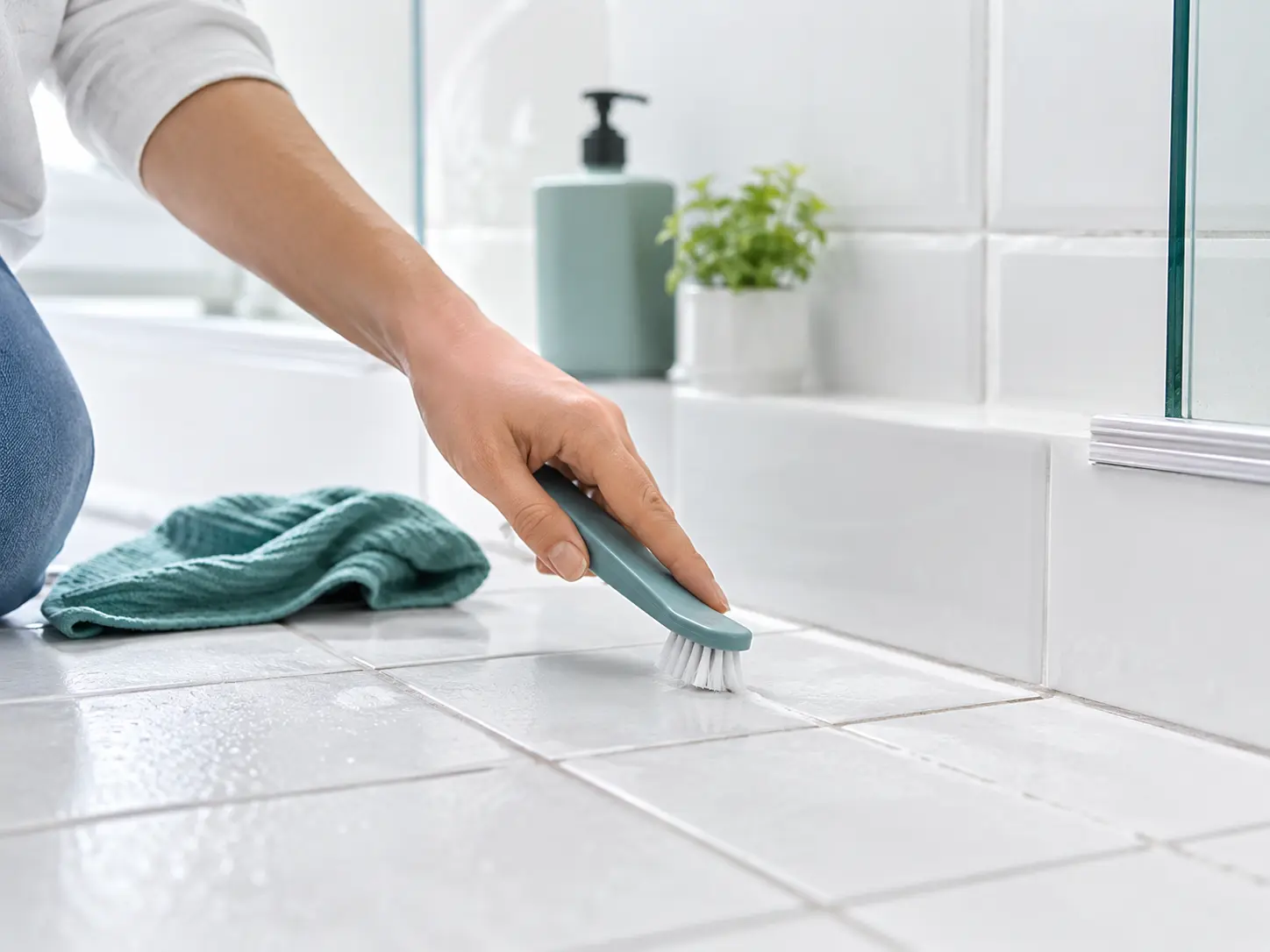
Bathrooms need weekly deep attention at minimum because warm, moist conditions accelerate mold and mildew growth on grout, silicone seals, and shower curtains. The Centers for Disease Control and Prevention recommends disinfecting bathroom surfaces regularly to reduce transmission of common pathogens including norovirus and influenza, particularly in households where bathrooms are shared by multiple people.
- Daily: wipe the sink and tap after use, squeegee shower glass or walls after the last shower of the day, hang towels to dry (never leave damp towels bunched on a rack)
- Weekly: scrub the toilet bowl, seat, and exterior with a disinfectant, clean the shower or bathtub including tile walls, wipe mirrors, mop the floor, replace hand towels
- Monthly: descale showerheads and taps (soak in white vinegar for 30–60 minutes), clean grout lines with a baking soda paste, wash the shower curtain or liner, clean the exhaust fan cover
- Quarterly: reseal grout if it is beginning to discolour despite cleaning, replace silicone caulk around the bathtub or shower tray if mould has penetrated below the surface, deep clean behind the toilet and under the vanity
In Singapore and other humid regions, the monthly grout-cleaning task should shift to fortnightly. Mould spores germinate faster in sustained humidity above 80%, and bathrooms without mechanical ventilation are especially vulnerable.
Bedroom
Bedrooms accumulate dust mites, dead skin cells, and allergens in mattresses, pillows, and soft furnishings more slowly than kitchens and bathrooms accumulate bacteria, but the long hours of direct skin contact with bedding make weekly linen changes important for both hygiene and sleep quality.
- Daily: make the bed, open curtains or blinds to let in natural light (UV exposure inhibits dust mite reproduction), put away clothes
- Weekly: change and launder all bed linens in water at 60 °C or above (this temperature kills dust mites), dust nightstands and dressers, vacuum the floor including under the bed
- Monthly: vacuum the mattress surface, flip or rotate the mattress if the manufacturer recommends it, dust ceiling fans and light fixtures, wipe down wardrobe interiors
- Quarterly: launder pillows and duvets (check care labels), vacuum behind and under the bed frame, clean windows and window tracks
Living areas
Living rooms, dining areas, and family rooms are high-traffic zones where food crumbs, pet hair, and foot-tracked dirt accumulate quickly. Cleaning frequency for living areas scales with household size and whether pets have access to these rooms.
- Daily: straighten cushions and throws, clear clutter from surfaces, wipe the dining table after meals
- Weekly: dust all surfaces including shelves, picture frames, and electronics, vacuum floors and rugs (twice weekly if pets are present), mop hard floors, wipe remote controls and light switches
- Monthly: vacuum upholstered furniture using the brush attachment, clean under sofa cushions, dust blinds or curtains, wipe down skirting boards and baseboards
- Quarterly: shampoo or steam-clean carpets and rugs, clean windows inside and out, wipe down walls and door frames
Floors, vacuuming, and mopping
Floor cleaning frequency depends on the floor material, foot traffic, and whether the household has pets or young children. As a general benchmark, the International Sanitary Supply Association recommends vacuuming high-traffic residential areas at least twice per week and mopping hard floors weekly to maintain hygiene and extend the floor’s lifespan.
- Hard floors (tile, vinyl, laminate, hardwood): sweep or vacuum daily in high-traffic areas, mop weekly with a floor-appropriate cleaner, deep clean (polish or reseal) annually
- Carpeted floors: vacuum twice per week in main living areas (daily if pets shed heavily), spot-treat stains immediately, shampoo or steam-clean every 6–12 months
- Rugs: vacuum weekly, rotate quarterly to distribute wear evenly, professional clean annually
The frequency of floor cleaning is one of the strongest predictors of how clean a home feels day to day. A home with sparkling countertops but visibly dirty floors still reads as unclean. The comparison between weekly, fortnightly, and monthly cleaning reveals how much floor grime, along with other tasks, gets missed at longer intervals.
Weekly vs fortnightly vs monthly cleaning
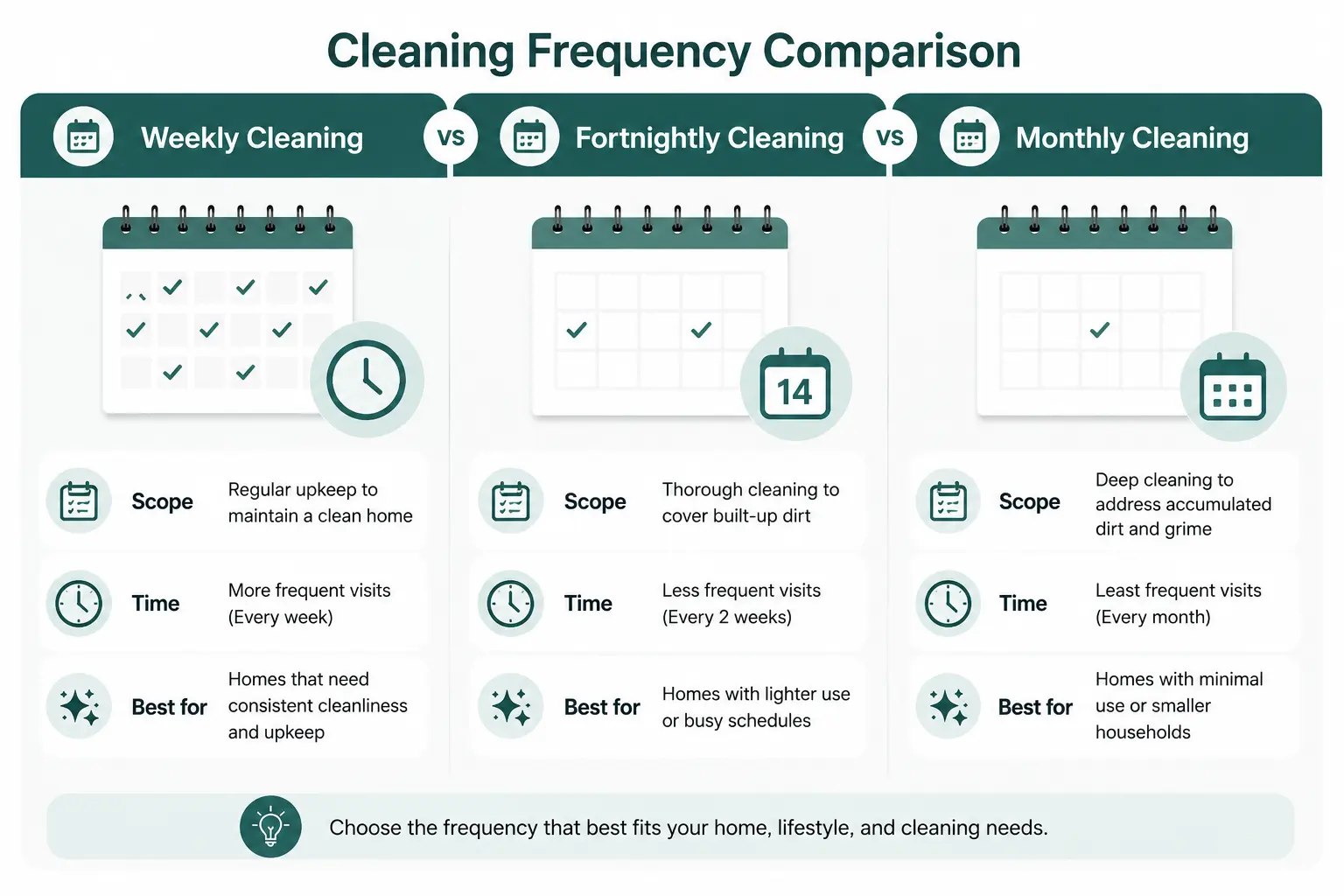
Among the three most common cleaning schedules, weekly cleaning covers the widest scope and prevents the greatest amount of buildup, but it also demands the most time and budget.
| Weekly | Fortnightly | Monthly | |
| Scope per session | Full standard clean (all rooms, all routine tasks) | Full standard clean + additional two-week buildup tasks | Full standard clean + significant one-month buildup, often requiring extra time for hardened grime |
| Time per session | 2–3 hours (smaller home) to 4–5 hours (larger home) | 3–4 hours to 5–6 hours | 4–6 hours to 7–8 hours |
| Sessions per month | 4 | 2 | 1 |
| Best for | Families with children, pet owners, allergy sufferers, anyone who prefers a consistently clean home | Couples or small households without pets, moderate traffic homes | Single occupants, minimal-traffic homes, budget-conscious households supplementing with daily maintenance |
The key trade-off is between cumulative buildup and cost. Fortnightly cleaning is the most popular frequency among professional cleaning clients because it balances cost and cleanliness, according to multiple residential cleaning companies including Molly Maid, Merry Maids, and Helpling. Homes cleaned fortnightly still receive 26 professional sessions per year, enough to prevent most forms of long-term grime accumulation, while costing roughly half of a weekly schedule.
Weekly cleaning becomes cost-effective when the alternative is replacing surfaces damaged by neglect. Grout exposed to mould for months may need resealing. Carpet fibres ground with dirt for weeks develop permanent discolouration. Kitchen range hoods caked with grease lose extraction efficiency and become fire hazards. The cost of these repairs often exceeds the savings from less frequent cleaning.
In Singapore, where part-time cleaners on platforms such as Helpling charge $21–$24 per hour for recurring weekly sessions and $24–$28 per hour for one-off bookings, the monthly budget for weekly cleaning of a 3-room HDB flat (approximately 65 sqm) ranges from $340–$400. Fortnightly sessions for the same flat cost approximately $170–$220 per month.
Home size also affects the right frequency. Studios and one-bedroom apartments generate less dust and foot traffic than four-bedroom houses, and their smaller surface area means a standard cleaning session covers everything in under two hours. Larger homes with multiple bathrooms, a dedicated kitchen, and outdoor areas may need weekly professional cleaning simply because no single session can address every room at a fortnightly interval without running to five or six hours.
The comparison above covers standard maintenance cleaning, but every home also needs periodic deep cleaning that resets surfaces standard sessions do not reach.
How often should you deep clean vs regular clean?
Deep cleaning is a more intensive process than regular cleaning, targeting areas and surfaces that routine weekly or fortnightly sessions do not cover, including inside ovens, behind appliances, under furniture, grout lines, and HVAC filters. Regular cleaning maintains an acceptable baseline; deep cleaning restores surfaces to a near-original condition.
Most cleaning professionals recommend deep cleaning every 3–6 months for an average household. The National Health Service in the United Kingdom advises regular deep cleaning of kitchens and bathrooms to reduce pathogen load, and the CDC recommends periodic intensive cleaning of shared surfaces in multi-person households. Households with pets, young children, or immunocompromised members should schedule deep cleaning every 2–3 months because allergen and pathogen accumulation accelerates in these environments.
Spring cleaning, a tradition in many cultures, functions as an annual deep clean timed to a seasonal or cultural reset. Deep cleaning can be scheduled at any point in the year, while spring cleaning specifically refers to the once-a-year whole-home effort. For a complete room-by-room spring cleaning checklist, see the spring cleaning checklist guide.
The distinction matters for budgeting. A regular cleaning session for a three-bedroom home costs $80–$200 depending on the market and the cleaner’s rate. A deep cleaning session for the same home costs $200–$500 because it takes roughly twice as long and often requires specialised equipment such as steam cleaners, grout brushes, and descaling solutions.
How frequently a household needs cleaning, whether regular or deep, also depends on who lives in the home and what their daily routines look like.
How does cleaning frequency change by household type?
Cleaning frequency adjusts based on who lives in the home, what activities generate mess, and whether the local climate accelerates dirt or microbial growth. The following five household profiles illustrate how the baseline weekly or fortnightly cleaning schedule should shift.
Working professionals (single or couple, no children, no pets): fortnightly cleaning is typically sufficient because the home sits empty during work hours and generates less foot traffic, food debris, and laundry. If both occupants work from home, weekly cleaning becomes more practical because the home is occupied and generates a mess continuously. A 15–20 minute daily maintenance routine (dishes, countertops, quick floor sweep) extends the interval between professional sessions.
Families with young children (under age 5): weekly cleaning is recommended because toddlers and infants interact with floors, surfaces, and soft furnishings at close range, increasing their exposure to dust, allergens, and bacteria. The American Academy of Pediatrics notes that infants who crawl on regularly cleaned floors have lower respiratory symptom rates than those in homes cleaned less frequently. High chairs, play mats, and bathroom surfaces used during bathing need daily disinfection.
Pet owners: weekly cleaning is the minimum for homes with dogs or cats because pet hair, dander, and tracked-in dirt accumulate on floors, furniture, and fabrics within days. Allergists recommend vacuuming with a HEPA-filter vacuum at least twice per week and washing pet bedding weekly in water at 60 °C to reduce airborne dander. Deep cleaning every 3–4 months specifically targets pet-related buildup in carpets, upholstery, and air ducts.
Allergy and asthma sufferers: weekly cleaning with biweekly vacuuming, combined with a monthly targeted deep clean, significantly reduces the allergen load in a home. Dust mites, the most common indoor allergen, double their population in mattresses and upholstered furniture roughly every six weeks when cleaning is infrequent, according to research published by the National Institute of Environmental Health Sciences. Using microfibre cloths (which trap rather than redistribute particles), HEPA-filter vacuums, and allergen-proof mattress covers amplifies the effect of each cleaning session.
Elderly households: weekly cleaning addresses both hygiene and safety. Clutter-free floors reduce fall risk, a leading cause of injury among adults over 65 according to the World Health Organization. Bathroom surfaces need frequent disinfection, especially for elderly residents with chronic health conditions. In some cases, professional cleaning doubles as a wellness check, with the cleaner flagging maintenance issues such as leaking taps or loose tiles that the resident may not notice.
Tropical and high-humidity environments (including Singapore): humidity between 70% and 90% accelerates mould growth on bathroom grout, kitchen splashbacks, and air-conditioning filters. In Singapore, where most homes are either HDB flats or condominiums with limited natural ventilation in wet areas, fortnightly bathroom deep cleaning and monthly air-conditioner filter cleaning should supplement the standard weekly or fortnightly schedule. Dust mites also thrive in tropical humidity, making weekly vacuuming of mattresses and upholstered furniture more important than in dry climates.
With the right cleaning frequency matched to the household, the remaining question is whether the cost of maintaining a consistent schedule is justified.
Is weekly cleaning worth it?
Yes, weekly cleaning is worth it for most households because the cost of maintaining a consistently clean home is lower than the cumulative cost of deferred maintenance, surface replacement, and the health consequences of prolonged allergen exposure. The trade-off is financial: weekly cleaning costs roughly twice as much as fortnightly cleaning per month.
Weekly cleaning is most clearly worth it for households that meet one or more of these criteria: children under five years old, one or more pets, a household member with allergies or asthma, a home larger than 90 square metres, or occupants who work from home full-time. In these scenarios, the cleaning load generated in a single week is substantial enough that a fortnightly cadence results in noticeable buildup by the second week, including visible dust on surfaces, pet hair on furniture, and bathroom soap scum that hardens if left for 14 days.
For smaller households without children or pets, fortnightly cleaning combined with a consistent 15-minute daily maintenance routine achieves a comparable result at half the cost. The key variable is whether the occupants maintain the daily routine; if they do not, the home’s condition by the time the fortnightly cleaner arrives may require a longer session, narrowing the cost gap.
Can you clean your house too often? Overcleaning is possible but uncommon in residential settings. Using harsh chemical disinfectants on surfaces daily can degrade sealants, dull natural stone, strip wood finishes, and irritate skin and airways. Daily sanitisation of every surface is unnecessary for most homes; it is appropriate only for food-preparation areas and shared bathroom touchpoints. Weekly cleaning with a thorough but non-abrasive approach is the practical ceiling for most rooms.
Is weekly cleaning worth it for an HDB flat? For a typical 3-room or 4-room HDB flat in Singapore (65–90 sqm), weekly cleaning costs approximately $85–$100 per session with a recurring booking through a platform such as Helpling. At $340–$400 per month, the cost is comparable to eating out twice fewer per month, and the return includes reduced mould risk (a genuine concern in HDB bathrooms with limited ventilation), lower dust-mite density in bedrooms, and consistently clean floors that are safe for children and elderly household members. Fortnightly cleaning at $170–$220 per month is a reasonable alternative for HDB flats occupied by one or two working adults without pets.
Building a routine that lasts matters more than any single cleaning session, because consistency determines long-term outcomes.
How do you build a cleaning routine that lasts?
A cleaning routine that lasts is one that fits the household’s actual schedule, energy levels, and budget rather than an aspirational standard that collapses within weeks. The most common reason cleaning routines fail is that they demand too much time in a single block, turning cleaning into a dreaded weekend chore instead of a distributed daily habit.
Start by anchoring one cleaning task to an existing daily habit. Wiping the kitchen counter immediately after cooking adds 90 seconds to meal cleanup. Squeegeeing the shower glass after the last shower of the day takes under a minute. These anchored tasks prevent the two biggest sources of residential grime, kitchen grease and bathroom moisture, from accumulating past the point where daily effort can manage them.
Assign one room per day for the weekly cleaning cycle instead of cleaning the entire home in a single session. Monday: kitchen. Tuesday: bathrooms. Wednesday: bedrooms. Thursday: living areas. Friday: floors throughout. Each session takes 20–40 minutes rather than consuming a three-to-four-hour weekend block. This distributed approach, recommended by cleaning experts including the American Cleaning Institute in their “Fast and Efficient Home Cleaning Guide,” is sustainable long-term because it never demands a large time commitment on any single day.
For tasks that exceed what daily and weekly routines cover, schedule quarterly and annual deep cleaning sessions on the calendar at the start of the year, the same way you would schedule a dental cleaning or car service. Treating deep cleaning as a planned appointment rather than a vague intention dramatically increases follow-through.
If the cleaning routine still feels unsustainable despite distributing tasks and anchoring habits, that is a signal to delegate. A recurring professional cleaning session on a weekly or fortnightly schedule removes the cognitive load of tracking what needs cleaning and when, replacing it with a fixed appointment that maintains the home at a consistent baseline. The cleaner handles the standard tasks; the household maintains the daily anchored habits between sessions. For homeowners in Singapore, a cleaning service through Helpling starts at $21 per hour with a vetted, insured cleaner assigned to the same household on a fixed schedule.