Fridge odors develop when food particles, spills, or expired items release volatile compounds inside a sealed, humid environment. Left unaddressed, these odors transfer to fresh groceries, mask early signs of spoilage, and make every meal prep session unpleasant. Removing fridge odors requires identifying the source, deep cleaning the interior surfaces, and using a deodorizer suited to the severity of the smell.
This guide covers what causes bad smells in a fridge, a step-by-step deep cleaning method, the best natural deodorizers and how long each one takes, what to do after a power outage, why persistent odors return even after cleaning, and when professional fridge cleaning makes more sense than a DIY approach.
What causes bad smells in a fridge?
Bad smells in a fridge are caused by bacteria breaking down organic matter, as documented by the United States Department of Agriculture Food Safety and Inspection Service (“Removing Odors from Refrigerators and Freezers”, USDA FSIS). Every food item emits trace volatile organic compounds during storage, and bacterial colonies accelerate the release of these compounds once food begins to spoil.
The most common sources of fridge odors are expired food, uncovered leftovers, spilled liquids that seep under shelves and into crevices, and produce that has rotted inside the crisper drawer. Fruit and vegetables leak pungent liquid when they decompose, and this liquid pools beneath drawer liners where it is easy to miss during routine wipe-downs.
Beyond food itself, the fridge’s own components contribute to odor buildup. The drip pan, located underneath the unit, collects condensation and food residue that breeds mould over time. Door gaskets, the rubber seals lining the fridge door, trap crumbs and moisture in their folds. A clogged drain hole prevents condensation from draining properly, creating a stagnant-water smell that persists even when the shelves appear clean.
Temperature also plays a role in fridge odor development. The National Environment Agency of Singapore recommends maintaining a refrigerator at 0°C to 4°C and a freezer at −18°C or below (“Guidelines on Proper Storage of Food in Refrigerators”, NEA). Above 4°C, bacteria enter the Temperature Danger Zone (5°C to 60°C per SFA guidelines) and multiply rapidly, accelerating food spoilage and the odors that accompany it.
Can fridge odors contaminate other food?
Yes, fridge odors can transfer to other food. Uncovered items, particularly dairy products, butter, and sliced fruit, absorb ambient volatile compounds from the fridge environment. Strong-smelling foods such as fish, durian, and fermented pastes release odors that permeate nearby items within hours. Storing all food in sealed containers or resealable bags prevents cross-contamination and reduces the overall odor load inside the fridge.
The relationship between fridge temperature and bacterial contamination underscores why regular cleaning matters for food safety, not just comfort.
How do you deep clean a fridge to remove odors?
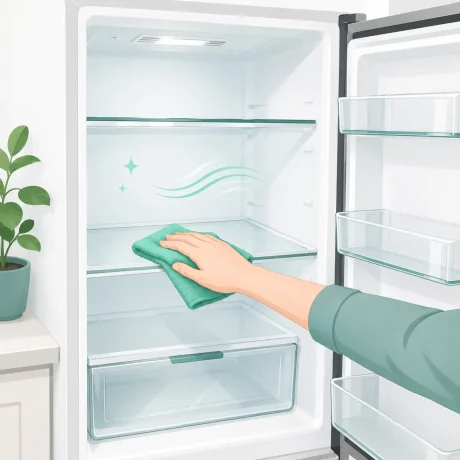
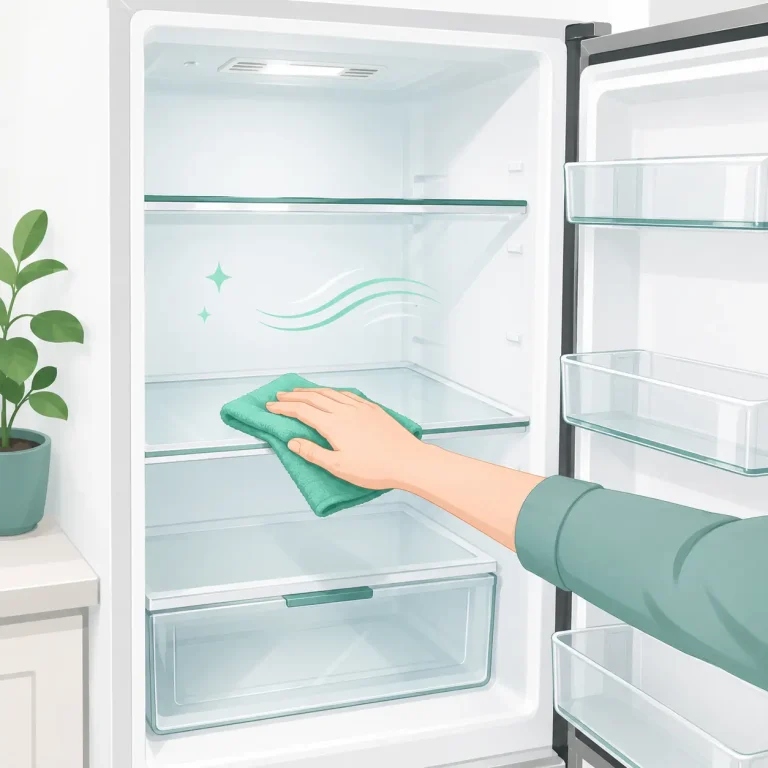
Deep cleaning a fridge to remove odors requires emptying the unit, washing every removable component, wiping all interior surfaces, and cleaning the hidden areas where residue accumulates. The steps below are listed in order.
- Remove all food and drinks. Transfer perishables to a cooler with ice packs or an insulated bag. Check expiration dates and discard anything expired, discoloured, or foul-smelling. Group similar items together for easy restocking later.
- Unplug the fridge. Disconnecting power prevents electrical hazards during wet cleaning and allows the interior to reach a temperature that makes dried residue easier to loosen.
- Remove all shelves, drawers, and bins. Let glass shelves reach room temperature before washing them, as cold glass can crack under hot water. Wash all removable parts in warm soapy water or a solution of two tablespoons of baking soda per litre of warm water. Rinse and dry each piece thoroughly before replacing.
- Wipe interior walls, ceiling, and floor. Use a clean cloth dampened with the same baking soda solution. For dried food spills, make a paste of baking soda and water, apply it to the stain, leave it for 10 to 15 minutes, and scrub gently with a soft brush. Follow with a vinegar-and-water spray (1:2 ratio) for natural disinfection.
- Clean the drain hole. Use a cotton swab dipped in hydrogen peroxide to clear any blockage in the drain channel. A clogged drain causes standing water and musty fridge odors.
- Clean the drip pan. Pull the fridge away from the wall, locate the drip pan at the bottom of the unit, and wash it with warm soapy water. Rinse thoroughly and dry before replacing.
- Reassemble and plug in. Return shelves, drawers, and bins. Plug the fridge back in and allow it to reach 4°C or below before restocking food.
How to clean fridge gaskets and door seals
Fridge gaskets collect crumbs, sticky residue, and mould in their folds. Dip an old toothbrush in a baking soda solution and scrub gently along the seal. Wipe with a damp cloth and dry completely. Test the seal by closing the door on a sheet of paper: if the paper slides out without resistance, the gasket may need replacement, as a weak seal allows warm air to enter the fridge and accelerate odor-causing spoilage.
Regular deep cleaning every three to four months, combined with weekly wipe-downs of shelves and immediate cleanup of spills, keeps fridge odors from returning. When residue embeds itself in surfaces that cleaning cannot reach, a natural deodorizer helps absorb the remaining volatile compounds.
What are the best natural deodorizers for a fridge?
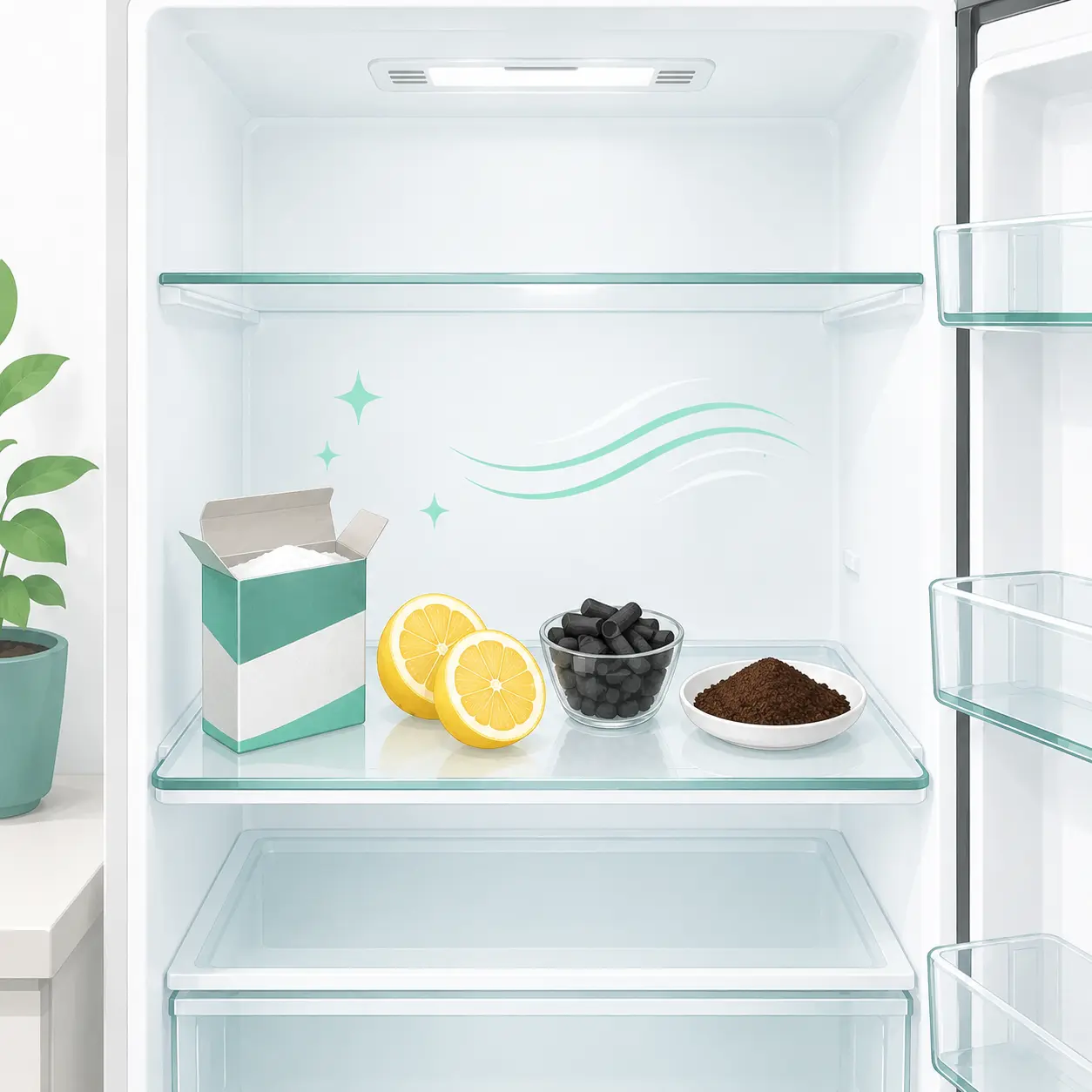
Natural deodorizers for a fridge are substances that absorb or neutralise volatile odor compounds without adding chemical residue to a food-storage environment. The following methods are listed below.
- Baking soda absorbs a broad spectrum of acidic and alkaline odor molecules. Place an open box or a shallow bowl of baking soda on a middle shelf. Replace monthly for continuous odor absorption. For a one-time intensive deodorising session, spread an entire box on a baking sheet, place it inside the fridge, and keep the door closed for 24 hours.
- White vinegar neutralises odors through its acetic acid content. Soak a small towel in undiluted white vinegar, place it in an open bowl, and leave it inside the fridge for 12 to 24 hours. Vinegar also works as a cleaning solution: mix equal parts vinegar and water in a spray bottle for routine shelf wipe-downs.
- Activated charcoal adsorbs odor molecules in its porous carbon structure, making it effective against strong, persistent fridge smells that baking soda alone does not eliminate. Place two to three shallow bowls of activated charcoal pellets on separate shelves, lower the temperature setting, and keep the door closed for two to three days. Activated charcoal can be refreshed by heating it in an oven at 180°C for 20 minutes.
- Coffee grounds contain nitrogen, which neutralises sulfur-based odor compounds. Spread dried, unused coffee grounds evenly on a plate and place it inside the fridge for 24 to 48 hours. Coffee grounds leave a mild coffee scent, which some users prefer as a replacement for stale food odors.
- Lemon provides both deodorising and antibacterial properties through its citric acid. Wipe interior surfaces with lemon juice using a clean cloth, or cut a lemon in half and place each half on a shelf. For a salt-and-lemon method common in Singapore households, hollow out a lemon half, fill it with table salt, and place it on the bottom shelf. The salt absorbs moisture while the lemon zest releases a fresh citrus scent.
- Uncooked oats absorb ambient moisture and odor compounds. Place a bowl of uncooked oats inside the fridge for two to three days, then discard.
Where to buy activated charcoal in Singapore
Activated charcoal pellets are available at Guardian and Watsons (aquarium supply section or health aisle), NTUC FairPrice Xtra (pet supplies section), and online through Shopee and Lazada (search “activated charcoal pellets” or “activated carbon”). Prices range from $5 to $20 for a 200g to 500g pack, enough for three to four fridge deodorising cycles.
The effectiveness of each deodorizer varies by method, duration, and severity of the fridge odor.
How long does each deodorizer take to work?
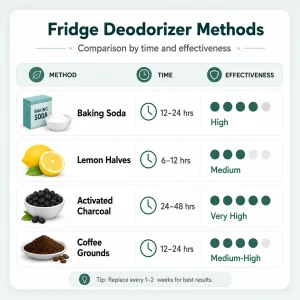
Each deodorizer absorbs fridge odors at a different rate depending on its mechanism, the volume of the fridge, and the intensity of the odor source. Among the six natural methods, activated charcoal and baking soda are the most effective for strong, persistent fridge smells, while lemon and coffee grounds work faster for mild, everyday odors.
| Method | Time to noticeable effect | Duration of effectiveness | Best for | Approximate cost (SGD) |
| Baking soda (open box) | 12–24 hours | 30 days before replacing | Mild to moderate everyday fridge odors | $2–$4 per box |
| Baking soda (full-sheet intensive) | 24 hours (door closed) | One session | One-time odor reset after deep clean | $2–$4 per box |
| White vinegar (soaked towel) | 12–24 hours | One session | Moderate odors + disinfection | $3–$5 per bottle |
| Activated charcoal | 2–3 days (door closed) | 30–60 days, refreshable | Strong, persistent odors (spoiled food, power outage) | $5–$15 per 200–500g |
| Coffee grounds | 24–48 hours | One session | Sulfur-based odors (eggs, seafood, durian) | Free (used grounds) to $5 (fresh) |
| Lemon (halved / salt-filled) | 2–6 hours | 3–7 days | Mild odors + pleasant scent overlay | $0.50–$1.50 per lemon |
| Uncooked oats | 2–3 days | One session | Moisture-heavy odors | $3–$6 per pack |
For severe fridge odors, combining methods produces faster results: deep clean the interior first (H2 #2), then place activated charcoal on the upper shelf and baking soda on the lower shelf simultaneously. Keep the fridge closed for 48 to 72 hours with no food inside.
Fridge odors caused by a specific event, such as a power outage, require a modified cleaning protocol before any deodorizer is effective.
How to remove fridge smell after a power outage
Removing fridge smell after a power outage starts with discarding all perishable food that exceeded safe temperature thresholds during the outage. The Singapore Food Agency advises that perishable items held above 4°C for more than two hours should be discarded, and any food with an unusual odor, colour, or texture should be thrown away regardless of the time elapsed (“Food Safety Tips”, SFA).
After a power outage lasting four hours or more, follow these steps to eliminate fridge odors:
- Discard all high-risk perishables. Raw meat, poultry, seafood, dairy, cooked rice, and cut fruit that spent more than two hours above 4°C should be discarded. Hard cheeses, butter, and unopened condiments are generally safe to keep unless they smell off.
- Deep clean the entire interior. Follow the full deep-cleaning protocol from H2 #2: remove shelves, wash with baking soda solution, wipe walls, clean the drip pan, and clean gaskets.
- Apply a two-stage deodoriser. After cleaning, place a baking sheet of activated charcoal inside the fridge and keep the door closed for two to three days. The charcoal adsorbs the deep odor residue that spoiled food leaves behind. Follow with an open box of baking soda for ongoing maintenance.
- Check the freezer separately. If the freezer lost power, food that partially thawed and refroze may have released liquid into the freezer floor and drain. Clean the freezer using the same protocol.
Power outages during Singapore’s thunderstorm season (November through January, and intermittently during the southwest monsoon from June to September) are the most common trigger for severe fridge odors that resist standard deodorising. When cleaning and charcoal treatment do not resolve the smell, the odor may have migrated into components that a surface wipe cannot reach.
Why does my fridge smell even after cleaning?
A fridge smells even after cleaning when the odor source is embedded in a component that standard cleaning does not reach. The most common hidden causes are listed below.
- Evaporator coils accumulate dust, grease, and food particles over years of use. Dirty coils circulate odor-laden air through the fridge even after the interior surfaces are clean. Evaporator coils sit behind the rear panel inside the freezer compartment. Vacuuming the condenser coils at the back or underside of the fridge with a brush attachment removes surface dust and improves airflow, but reaching the evaporator coils typically requires a technician.
- The drip pan is the most overlooked odor source, as documented by Anita’s Housekeeping (“3 Reasons Your Fridge Smells Bad Even After Cleaning It”). Moisture collects in the pan and supports mould growth that produces a persistent musty fridge smell. Even after washing the drip pan, residual bacteria in the pan’s plastic can re-establish odor colonies within weeks.
- Odor-absorbing plastic is a structural cause of persistent fridge odors. The plastic lining of fridge walls, drawers, and shelves absorbs volatile odor molecules over time, particularly from spoiled meat, fermented food, and durian. Once absorbed, these odors slowly release back into the fridge environment. An antibacterial cleaner may help, but in severe cases the plastic retains the odor permanently.
- Damaged or worn door gaskets allow warm, humid air to enter the fridge. This raises the internal temperature above the safe 0–4°C range, accelerates bacterial growth on food surfaces, and produces new odor sources faster than deodorizers can absorb them.
- A blocked drain hole causes standing water inside the fridge that develops a stagnant, sour fridge smell. The drain hole connects to the drip pan; if food debris blocks it, condensation pools on the fridge floor instead of draining.
When troubleshooting a persistent fridge odor, check each of these components in order. If the fridge still smells after addressing all five, the issue may be mechanical (a failing compressor or refrigerant leak producing a chemical odor), which requires a certified appliance technician.
The distinction between a cleanable surface odor and an embedded component odor determines whether a DIY approach is sufficient or whether professional intervention makes sense.
Should you hire a professional for deep fridge cleaning?
Yes, hiring a professional for deep fridge cleaning is worth considering when the fridge odor persists after a thorough DIY deep clean and two rounds of deodoriser treatment. A professional fridge cleaning service reaches components that household cleaning cannot access, including evaporator coils, internal drain lines, and the compressor housing area.
Situations where professional cleaning is the more effective choice include persistent odors after a power outage where food spoiled for more than 24 hours, recurring mould growth in the drip pan or gasket folds despite monthly cleaning, a chemical or mechanical smell that suggests a refrigerant issue, and health-sensitive households with infants, elderly residents, or immunocompromised members where food safety standards are stricter.
Professional fridge cleaning in Singapore typically costs $80 to $200 depending on the fridge size and the severity of the odor. The service includes interior sanitisation with food-safe disinfectants, gasket deep cleaning, drip pan cleaning, and exterior wipe-down. Some providers also vacuum condenser coils and inspect gasket seals as part of the service.
Can a DIY approach replace professional fridge cleaning?
A DIY approach handles mild to moderate fridge odors effectively, covering surface cleaning, shelf washing, and deodoriser placement. For strong, embedded odors or odors tied to mechanical components (evaporator coils, drain lines, compressor area), professional cleaning provides equipment and access that household tools do not replicate.
Helpling’s cleaning service covers interior sanitisation, shelf and drawer cleaning, gasket deep cleaning, and drip pan cleaning as part of a single session. The service can also be added to Helpling’s standard cleaning package for households that want fridge cleaning as part of a regular home cleaning schedule, with all cleaners covered by $1M public-liability insurance.