

Keeping your house clean is less about marathon weekend cleaning sessions and more about building small, consistent habits that prevent dirt, dust, and clutter from accumulating past a manageable threshold. The difference between a home that always looks presentable and one that requires a full day of cleaning every Saturday is not the amount of effort involved but the way that effort is distributed across the week. Preventive cleaning, the practice of stopping messes before they form, replaces reactive cleaning, the practice of removing messes after they have grown, and the result is a home that stays clean with less total time invested.
This guide covers what keeping a clean house involves and how it differs from periodic deep cleaning, daily habits that prevent buildup including the one-touch rule and the nightly reset, weekly tasks that maintain a baseline, monthly and seasonal tasks for long-term maintenance, room-by-room methods for kitchens, bathrooms, bedrooms, and living areas, which cleaning system fits busy households best, adjustments for homes with children, pets, or roommates, whether daily micro-cleaning or weekly sessions produce better results, and when hiring a professional cleaner makes more sense than doing it yourself.
What does keeping a clean house involve?
Keeping a clean house is the ongoing practice of maintaining living spaces at a hygienic, organised baseline through distributed daily effort rather than concentrated periodic sessions, as described by the American Cleaning Institute in its “Fast and Efficient Home Cleaning Guide.” Related terms include home maintenance routine, cleaning upkeep, and household cleanliness management.
The distinction between cleaning a house and keeping a house clean matters. Cleaning is reactive: it removes dirt, grease, dust, and bacteria that have already accumulated on surfaces. Keeping a house clean is preventive: it distributes small tasks across the day and week so that surfaces never reach the point where a dedicated cleaning session is necessary.
Both approaches are required, but the balance between them determines how much total time and energy a household spends on housework. A home that relies entirely on reactive cleaning demands 3-5 hours of concentrated effort every week or fortnight. A home that layers preventive daily habits on top of a lighter weekly routine reduces that concentrated effort to 1-2 hours because grime never builds past a manageable level.
Home cleanliness maintenance falls into three tiers. Daily maintenance covers the 10-15 minutes of tidying and surface wiping that prevent visible mess from forming overnight. Weekly standard cleaning covers the 1-3 hour session that addresses vacuuming, mopping, bathroom scrubbing, and dusting. Periodic deep cleaning covers the quarterly or biannual session that targets areas neither daily nor weekly routines reach, including oven interiors, grout lines, behind appliances, and mattress surfaces.
The most impactful tier is daily maintenance, because it determines whether weekly sessions feel like light upkeep or heavy recovery.
What daily cleaning habits keep your house clean?
Daily cleaning habits that keep your house clean fall into three categories: prevention habits that stop messes from forming, maintenance habits that address messes immediately, and reset habits that return each room to its starting state before the day ends.
The following three methods are the most widely recommended daily cleaning practices. Each takes less than five minutes individually and, combined, keeps a home visibly clean with under 20 minutes of total daily effort.
The one-touch rule
The one-touch rule is the practice of handling each object only once before it reaches its final destination, eliminating the intermediate steps that create clutter. Instead of setting a jacket on a chair with the intention of hanging it up later, the one-touch rule requires hanging it in the closet immediately. Instead of placing dishes on the counter to deal with after dinner, the rule requires loading them directly into the dishwasher.
The one-touch rule works because clutter forms when items land on surfaces temporarily and then stay there. Each temporary placement adds visual noise and creates a secondary task, moving the item to its actual home, that competes with other priorities throughout the day. Katie Berry, a cleaning expert whose advice appears in publications including HGTV Magazine and Real Simple, describes the one-touch principle as the single habit that produces the largest visible difference in home cleanliness with the least time investment.
Applying the one-touch rule consistently takes 2-3 weeks to become automatic. Start with one high-traffic area, such as the kitchen counter or the entryway table, and expand to the rest of the home once the habit holds.
The 10-minute nightly reset
The 10-minute nightly reset is a timed session at the end of each day in which every member of the household spends 10 minutes returning one or two rooms to their starting state. The goal is not perfection but a visible return to order: surfaces cleared, cushions straightened, stray items put away, dishes loaded, and the kitchen counter wiped clean.
Setting a timer matters. Without a boundary, the nightly reset expands from 10 minutes into an open-ended cleaning session that feels burdensome. With a timer, the session stays brief enough that it never becomes the kind of chore people postpone. Clean and Scentsible, a home management site run by Jenn Lifford, recommends making the nightly reset a family activity because shared effort reduces individual resentment and builds cleaning habits in children simultaneously.
The nightly reset is most effective when focused on the kitchen and the main living area, the two rooms that accumulate the most visible disorder during the day. Waking up to a clean kitchen and a tidy living room sets a psychological baseline that makes maintaining the rest of the home feel achievable.
Habit stacking
Habit stacking is the practice of pairing a cleaning task with an existing daily routine so that the cleaning task happens automatically rather than requiring a separate decision. The concept comes from behavioural research on habit formation: attaching a new behaviour to an established cue makes the new behaviour more likely to persist long-term, according to Dr. Phillippa Lally’s research at University College London, which found that new habits take between 18 and 254 days to become automatic depending on complexity.
Practical cleaning stacks include wiping the bathroom mirror and sink immediately after brushing your teeth in the morning, wiping the kitchen counter and stovetop immediately after cooking each meal, starting a load of laundry when the morning alarm goes off and switching it to the dryer before leaving for work, and squeegeeing the shower glass immediately after the last shower of the day. Each of these stacks adds 60-90 seconds to an existing routine but eliminates a cleaning task that would otherwise require its own time slot.
The common thread across all three daily methods, one-touch, nightly reset, and habit stacking, is that none of them require dedicated cleaning time. They distribute cleaning effort into gaps that already exist in the day. The weekly tasks that sit on top of this daily foundation then become faster because surfaces start each week close to clean rather than buried under a week of accumulated mess.
What weekly cleaning tasks prevent buildup?
Weekly cleaning tasks that prevent dirt, dust, and grime from accumulating beyond a manageable threshold are the backbone of any sustainable home cleaning routine. When daily habits handle the visible messes, weekly tasks handle the invisible ones: dust settling on shelves, bacteria multiplying in bathroom grout, and allergens embedding in carpet fibres.
A practical weekly cleaning routine covers the following tasks, distributed across the week rather than crammed into a single session:
- Vacuuming all floors, including under furniture edges and along baseboards, removes dust, pet hair, and tracked-in dirt before it grinds into carpet fibres or scratches hard-floor finishes. The International Sanitary Supply Association recommends vacuuming high-traffic residential areas at least twice per week to maintain hygiene and extend floor lifespan.
- Mopping hard floors with a damp microfibre mop and a floor-appropriate cleaner removes the fine grit and residue that vacuuming alone cannot capture.
- Scrubbing bathroom sinks, toilets, and shower surfaces with a disinfectant prevents bacterial and mould colonies from establishing. Cleaning these surfaces weekly keeps them at a level where a five-minute wipe maintains them; skipping a week lets buildup harden into deposits that require abrasive scrubbing.
- Dusting shelves, furniture, and electronics with a microfibre cloth traps particles rather than redistributing them into the air, which matters for households with allergy or asthma sufferers.
- Changing bed linens and laundering them in water at 60 degrees Celsius kills dust mites and removes the accumulated dead skin cells, sweat, and oils that feed them.
- Wiping kitchen appliance exteriors, cabinet handles, and light switches removes the grease film and fingerprints that make a kitchen look dingy even when the counters are clean.
- Emptying and replacing rubbish bin liners throughout the home prevents odour buildup and reduces insect attraction, particularly in tropical climates where organic waste decomposes faster.
Distributing these tasks across the week rather than saving them for one session is the key to sustainability. Assigning one room per day, for example kitchens on Monday, bathrooms on Tuesday, bedrooms on Wednesday, living areas on Thursday, and floors throughout the home on Friday, keeps each session to 20-40 minutes instead of a three-to-four-hour weekend block. This distributed approach prevents the cleaning session from becoming the kind of dreaded chore that households postpone until the home reaches a critical state.
Weekly tasks prevent buildup, but some surfaces and areas accumulate dirt on a longer cycle that daily and weekly routines do not address.
What monthly and seasonal tasks keep a house clean long-term?
Monthly and seasonal cleaning tasks address the surfaces, spaces, and systems that daily habits and weekly routines do not reach but that degrade home cleanliness, air quality, and appliance performance if neglected over time.
Monthly tasks target the medium-cycle maintenance items:
- Cleaning the interior of the oven, microwave, and dishwasher removes baked-on food residue and grease that affects cooking performance and creates odours. Running an empty dishwasher cycle with a cup of white vinegar on the top rack descales internal components and clears drain buildup.
- Washing windows on the interior side removes the film of cooking grease, condensation residue, and dust that dims natural light and makes rooms feel smaller.
- Cleaning ceiling fans and light fixtures removes the dust layer that accumulates on upper surfaces and redistributes into the air each time the fan runs.
- Vacuuming upholstered furniture using the brush attachment removes trapped crumbs, pet hair, and dust mites from sofa cushions, armchairs, and dining chairs.
- Wiping skirting boards, baseboards, and door frames removes the dust line that forms along horizontal edges and that weekly floor cleaning does not capture.
- Descaling taps and showerheads by soaking in white vinegar for 30-60 minutes prevents mineral buildup from restricting water flow, especially in areas with hard water.
Seasonal tasks (quarterly or aligned with cultural resets such as spring cleaning, Lunar New Year, or year-end) target the long-cycle maintenance items:
- Deep cleaning the range hood filter and exhaust ductwork removes accumulated grease that reduces extraction efficiency and poses a fire risk in heavy-use kitchens.
- Carpet shampooing or steam cleaning restores carpet fibres and removes allergens, stains, and odours that regular vacuuming cannot extract.
- Rotating and deep-cleaning mattresses extends mattress lifespan and reduces dust mite populations in bedrooms.
- Clearing out wardrobes and storage areas, donating or discarding items not used in the past year, and reorganising the remaining contents prevents storage spaces from becoming clutter reservoirs that spill into living areas.
- Cleaning behind and underneath major appliances (refrigerator, washing machine, oven) removes the dust and debris that accumulates in these hidden zones and can harbour pests or reduce appliance efficiency.
For a comprehensive seasonal cleaning checklist, see the spring cleaning checklist guide. Monthly and seasonal tasks provide the structural reset that keeps the home in good condition year-round, but the day-to-day feel of a clean house depends on how well each individual room is maintained between these deeper sessions.
How do you keep each room clean?
Room-by-room cleaning methods distribute maintenance effort across the functional zones of a home so that each room receives the specific type of attention its surfaces and usage patterns demand. A kitchen requires different prevention strategies than a bedroom because the sources of mess, grease and food residue versus dust and fabric fibres, behave differently and accumulate at different rates.
Kitchen
The kitchen generates the most cleaning demand of any room because cooking produces grease aerosol, food residue, and moisture on a daily basis. Prevention in the kitchen means intercepting messes at their source rather than allowing them to settle and harden.
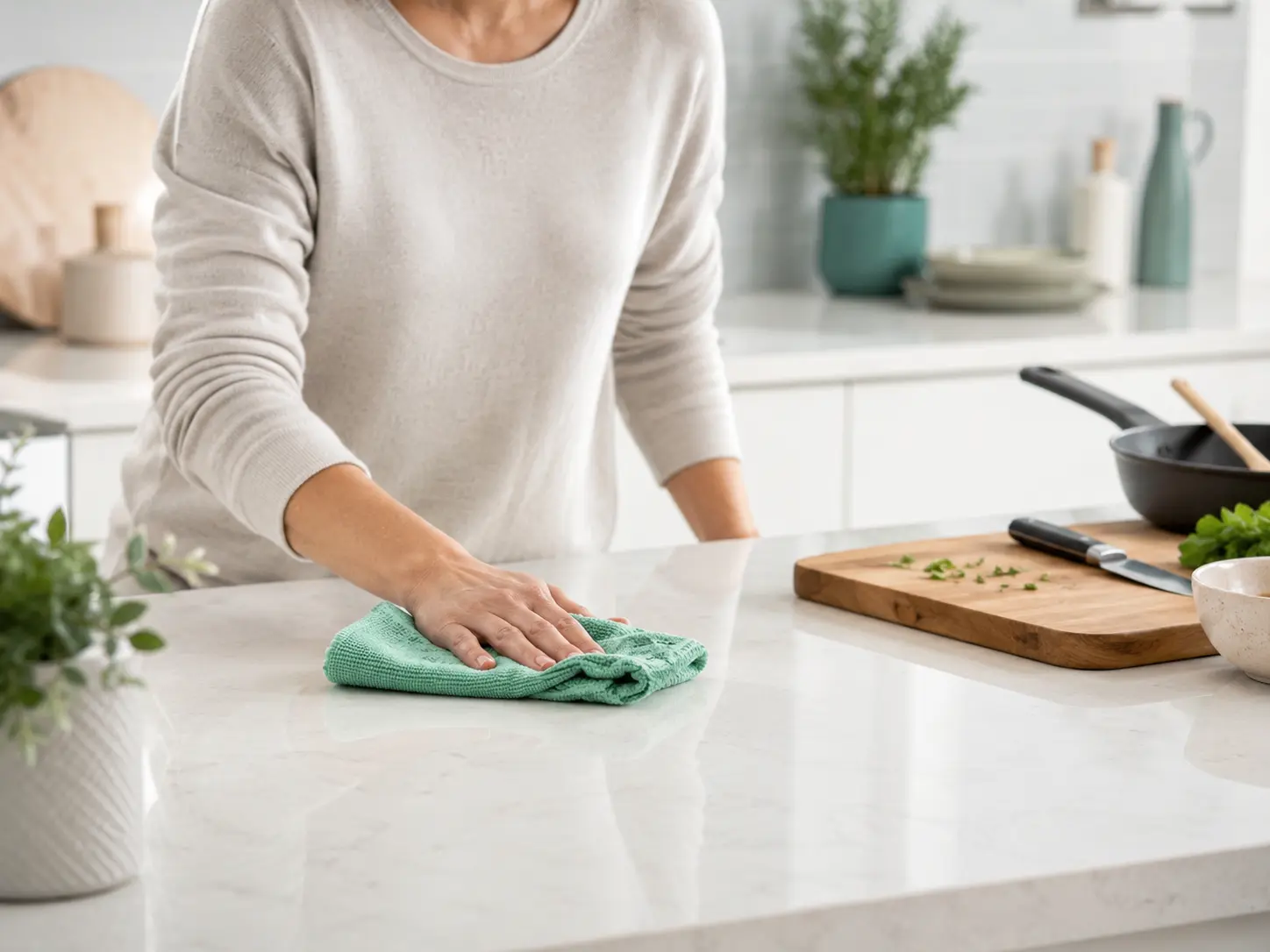
Wipe the stovetop and surrounding counter surfaces immediately after each cooking session while residue is still warm and soft. This 90-second task eliminates the need for the 15-minute scrubbing session that hardened grease requires by the end of the week.
Keep a spray bottle of all-purpose cleaner and a microfibre cloth within arm’s reach of the cooking area so that the barrier to cleaning is zero. Run the dishwasher every evening after dinner and empty it while the morning coffee brews, a five-minute task that keeps dirty dishes from accumulating on the counter. The American Cleaning Institute notes that counter clutter is the single largest contributor to the perception that a kitchen is unclean, even when surfaces underneath are sanitary.
In tropical climates, including Singapore, year-round humidity between 70% and 90% accelerates grease buildup on range hood filters and splashbacks. Wiping these surfaces after each cooking session rather than waiting for the weekly clean prevents grease from bonding with airborne moisture into a film that requires heavy-duty chemical removers.
Sink cleaning is the other high-impact kitchen task. Dr. Charles Gerba, a microbiologist at the University of Arizona, has documented that the average kitchen sink harbours more bacteria per square centimetre than the average toilet seat, making a nightly sink scrub with disinfectant a hygiene measure as much as a cosmetic one.
Bathroom
Bathrooms require daily micro-maintenance because warm moisture accelerates mould, mildew, and bacterial growth on grout, silicone seals, and fixtures. The prevention principle in the bathroom is removing moisture before it becomes a growth medium.
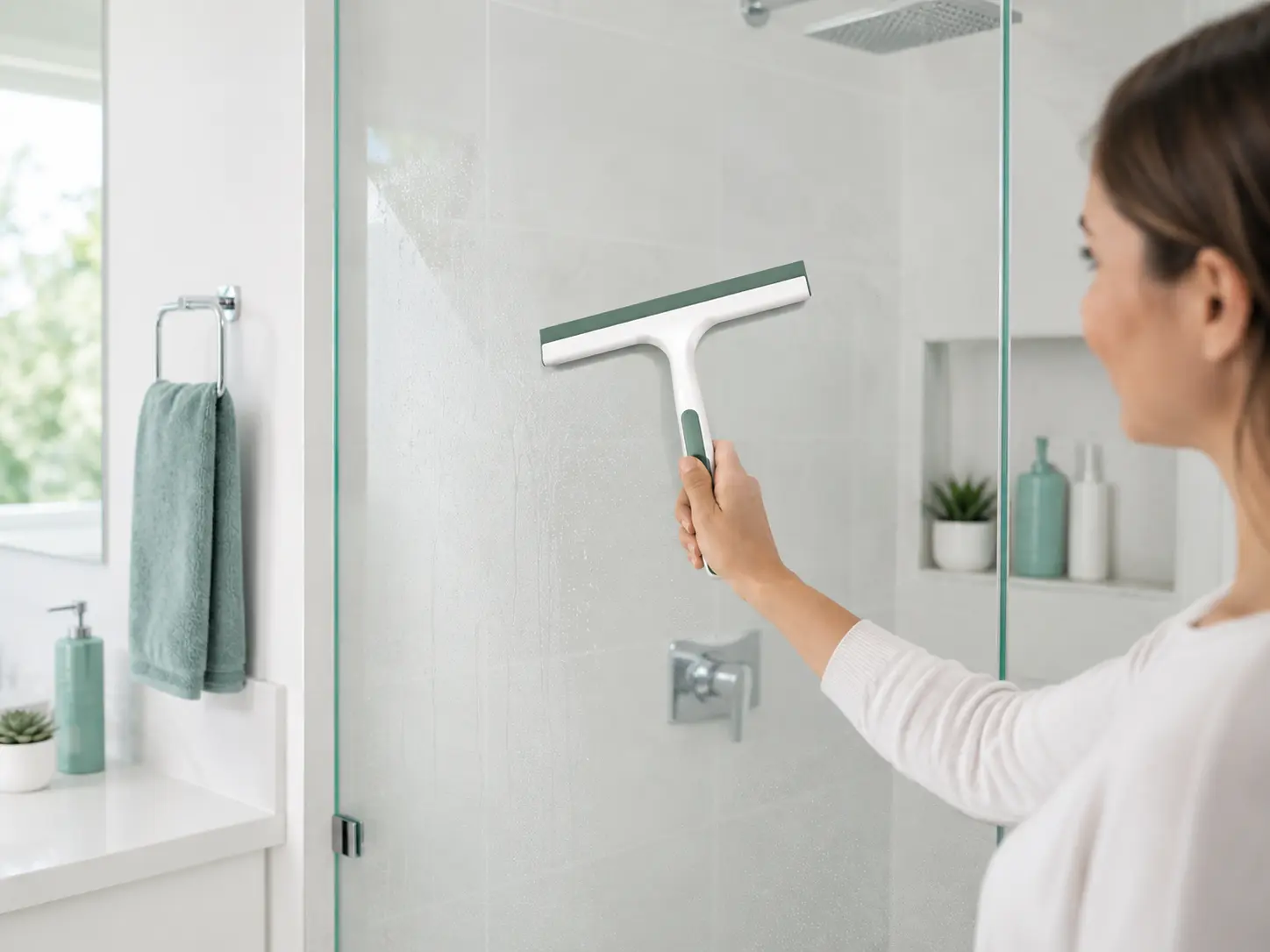
Squeegee the shower glass and tile walls immediately after the last shower of the day. This 30-second habit prevents water spots, soap scum, and the mineral deposits that create a permanently hazy appearance on glass surfaces. Wipe the sink and tap after brushing teeth in the morning, a habit-stacking task that adds 20 seconds to the existing routine but keeps toothpaste splatters from drying into spots that require scrubbing by the end of the week. Hang towels spread open on a rail rather than bunched on a hook; bunched towels dry slowly and develop a musty smell that signals to residents and guests that the bathroom is not clean.
In Singapore and other tropical regions, where sustained humidity above 80% creates ideal conditions for mould spore germination, the weekly grout-cleaning task should shift to every three to four days for bathrooms without mechanical ventilation. Keeping the bathroom door open after showering and running the exhaust fan for 15-20 minutes accelerates surface drying and slows mould colonisation on silicone seals.
Bedroom
Bedrooms accumulate allergens and dust rather than grease and bacteria, making the prevention focus different from kitchens and bathrooms. The two highest-impact bedroom habits are making the bed immediately after waking and keeping surfaces clear.
Making the bed takes under two minutes and transforms the visual state of the entire room. A made bed signals order and makes the rest of the room feel cleaner even when other surfaces carry a light dust layer. Simplify the bedding setup to reduce the friction of bed-making: a duvet with a washable cover and two pillows is faster to arrange than a layered system with a top sheet, multiple decorative pillows, and a folded throw.
Keep the nightstand and dresser surfaces clear of everything except essentials. Each object on a surface creates a pocket where dust accumulates and an obstacle that makes wiping the surface harder. The fewer items on bedroom surfaces, the faster weekly dusting becomes. Open curtains or blinds first thing in the morning; UV light exposure inhibits dust mite reproduction and signals the room’s daily reset.
Living areas
Living rooms, dining areas, and family rooms are high-traffic zones where foot-tracked dirt, food crumbs, and shed materials (hair, pet fur, fabric fibres) accumulate fastest on floors and upholstered surfaces.
The most effective living-area prevention habit is the “never leave empty-handed” rule: each time you walk from one room to another, scan for one item that belongs elsewhere and take it with you. This habit eliminates the gradual clutter drift that turns a tidy living room into a disorganised one over the course of a week. Place a small basket near the main living area for items that belong in other rooms; empty the basket during the nightly reset.
Wipe the dining table after each meal, not just dinner. Breakfast crumbs left on the table attract more items throughout the day as the surface becomes a convenient landing zone for keys, mail, and miscellaneous objects. Keeping the table clear maintains it as a functional surface rather than a clutter magnet.
For homes with upholstered furniture, keep a lint roller and a microfibre cloth within reach of the main sofa. A quick pass after each sitting session prevents pet hair and fabric fibres from embedding deeply enough to require vacuuming. The right cleaning approach for each room depends on the room’s specific mess profile, but the system used to organise all these room-level tasks across the week determines whether the routine is sustainable.
What cleaning system works best for busy households?
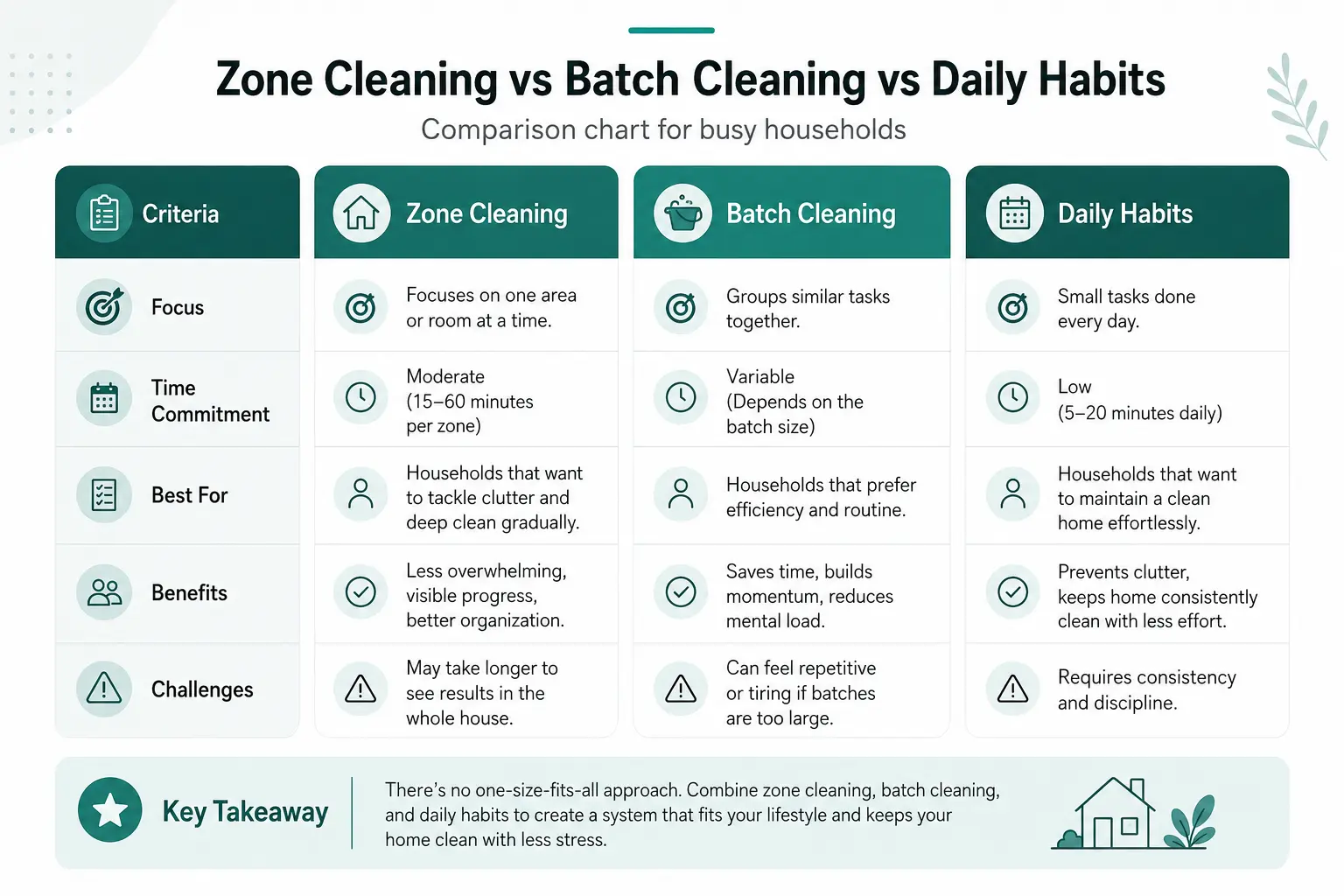
Among the three most widely used cleaning systems, zone cleaning, batch cleaning, and daily-habits cleaning each distribute effort differently and suit different household sizes, schedules, and temperaments.
| System | How it works | Time per day | Best for | Limitation |
| Zone cleaning | Divide the home into 4-5 zones; assign one zone per day; rotate weekly so every zone gets full attention once per week. | 20-40 min | Larger homes (3+ bedrooms), households where different rooms generate different levels of mess. | Zones cleaned later in the week may feel neglected by day 4-5; requires discipline to stay in-zone. |
| Batch cleaning | Group similar tasks (all dusting, all vacuuming, all bathrooms) and complete each batch in a single session, typically 1-2 batches per day. | 15-30 min per batch | People who prefer focus and completion over variety; households with consistent daily schedules. | Requires switching between rooms frequently within each batch, which can feel disruptive. |
| Daily-habits cleaning | Distribute micro-tasks throughout the day via habit stacking and the nightly reset; no dedicated “cleaning time” block. | 15-20 min total (distributed) | Smaller homes (studios, 1-2 bedrooms), working professionals with unpredictable schedules, anyone who dislikes dedicated cleaning sessions. | Does not scale well for homes above 100 square metres; weekly supplementary session still needed for floors and bathrooms. |
Most households benefit from combining elements of two systems rather than adopting one exclusively. The most common hybrid is daily-habits cleaning for prevention (one-touch rule, habit stacking, nightly reset) combined with zone cleaning or batch cleaning for the weekly deeper tasks (vacuuming, mopping, bathroom scrubbing). The daily-habits layer handles the visible surfaces; the weekly system layer handles the embedded dirt.
For smaller apartments, including HDB flats and condominiums in Singapore where typical unit sizes range from 45 to 120 square metres, the daily-habits approach alone is often sufficient for maintaining cleanliness between professional cleaning sessions. For landed homes or larger units with multiple bathrooms, zone cleaning provides better coverage because it ensures every room receives weekly attention without any single session exceeding 40 minutes.
The right cleaning supplies also affect system efficiency. Keeping a basic kit, a spray bottle of all-purpose cleaner, microfibre cloths, a scrub brush, and a squeegee, in each bathroom and the kitchen eliminates the time spent gathering supplies before each task. Which system works best also depends on who lives in the household, because children, pets, and shared living arrangements each introduce variables that shift the cleaning load.
How do you keep a clean house with kids, pets, or roommates?
How you keep a clean house changes depending on who lives in it, because each household composition introduces specific mess patterns that require targeted adjustments to the daily, weekly, and system-level routines.
With children:
The primary cleaning challenge is volume and unpredictability. Children generate messes faster than adults, in different locations (floor-level rather than counter-level), and with materials (paint, play dough, food thrown from high chairs) that adults rarely use. The three most effective adjustments are toy rotation, child-height cleaning access, and age-appropriate chore assignment. Toy rotation means keeping only one set of toys accessible at a time and storing the rest; fewer accessible toys mean fewer items on the floor and a faster nightly reset.
Place child-height hooks for coats, low bins for shoes, and open-top baskets for toys so that children can put items away independently rather than creating adult-dependent bottlenecks. Assign age-appropriate chores starting from age 3: putting toys in the basket, placing cups in the dishwasher, and wiping the table with a damp cloth. Children who participate in cleaning from a young age develop the habit as a normal part of daily life rather than a punitive task.
With pets:
The primary cleaning challenge is fur, dander, paw prints, and odour. Dogs and cats shed continuously, and pet hair embeds in carpets, upholstery, and clothing within hours of the last vacuuming session. The three most effective adjustments are a pet station, a paw-cleaning routine, and increased vacuuming cadence.
Designate one area near the main entry door as the pet station, equipped with a towel for paw wiping, a leash hook, and a mat that catches tracked-in dirt before it reaches the main living area. Wipe paws with a damp cloth after every outdoor walk. Vacuum high-traffic areas and pet-favourite resting spots every two to three days rather than once per week; a lightweight cordless vacuum stored in the living area reduces the friction of frequent vacuuming. Wash pet bedding weekly in water at 60 degrees Celsius to control dander and odour.
With roommates:
The primary cleaning challenge is coordination and accountability. Shared living arrangements fail when cleaning expectations are implicit rather than explicit, and when one resident’s tolerance for mess is significantly higher than another’s. The three most effective adjustments are a visible common-area schedule, shared supply access, and a weekly check-in. Post a simple weekly rotation (each roommate owns one common area per week: kitchen, bathroom, living area) in a shared location, physical or digital.
Stock cleaning supplies in each common area so that the person responsible never has to hunt for products. Schedule a brief weekly check-in, even two minutes, to flag any issues before resentment builds. The goal is to make cleaning expectations visible and measurable rather than relying on goodwill.
The cleaning load generated by children, pets, or roommates often raises the question of whether daily maintenance or weekly concentrated cleaning produces better results for the household.
Is it better to clean a little every day or do one big weekly session?
Both. Daily micro-cleaning and weekly sessions serve different purposes, and a home maintained with only one of them will either look cluttered between sessions (weekly only) or accumulate embedded dirt that daily surface cleaning cannot reach (daily only).
Daily cleaning handles the visible layer: counters, dishes, clutter, visible floor debris, and bathroom surfaces that interact with moisture. These tasks take 15-20 minutes total when distributed through habit stacking and the nightly reset. The return on this investment is disproportionately large because visible cleanliness drives the psychological experience of living in a clean home.
A study published by the Personality and Social Psychology Bulletin found that people who described their homes as “cluttered” or “full of unfinished projects” had higher cortisol levels throughout the day than those who described their homes as “restful” and “restorative,” suggesting that daily maintenance contributes to stress reduction beyond the hygienic benefit.
Weekly cleaning handles the invisible layer: dust on shelves, allergens in carpets, bacteria in bathroom grout, and the fine grime on floors that daily sweeping does not capture. These tasks require tools (vacuum, mop, scrub brush) and time (1-3 hours per session depending on home size) that daily routines cannot accommodate.
The optimal combination is daily habits for prevention and a weekly session, whether self-performed or professional, for restoration. Dr. Phillippa Lally’s research at University College London on habit formation indicates that new behaviours become automatic in 21-66 days depending on complexity, so a household that commits to the daily layer for two months will find that it requires negligible conscious effort afterward, freeing attention for the weekly session.
Can you keep a house clean without cleaning every day?
Yes, if the home is small (studio or one-bedroom), occupied by one or two adults without pets, and the weekly session is thorough enough to reset every surface. In larger homes or busier households, skipping daily maintenance means the weekly session must compensate for seven days of accumulated mess, extending it from 1-2 hours to 4-5 hours and transforming it into the kind of dreaded chore that households postpone.
For households where even the daily-plus-weekly combination cannot keep up with the cleaning demand, the next question is whether professional help is the more efficient path.
When should you hire a professional cleaner?
You should hire a professional cleaner when the gap between the household’s cleaning demand and its available cleaning time consistently exceeds what daily habits and weekly routines can bridge. This gap widens under predictable conditions: the home exceeds 80-100 square metres, the household includes children and pets simultaneously, both adults work full-time outside the home, anyone in the household has a chronic health condition that makes physical cleaning difficult, or the local climate accelerates dirt and mould accumulation faster than a daily routine can manage.
The threshold is practical rather than aspirational. Hiring a professional cleaner is not an admission that the household has failed at cleaning; it is a recognition that the household’s time has higher value elsewhere, whether in work, family, rest, or any other priority that cleaning displaces. The Good Housekeeping Institute notes that households spending more than 4-5 hours per week on cleaning, the equivalent of half a working day, are strong candidates for outsourcing at least the weekly session to a professional.
Professional cleaning also introduces a consistency baseline that self-managed routines often lack. A cleaner who arrives on a fixed schedule, whether weekly or fortnightly, maintains the home at a stable level regardless of the household’s energy, schedule, or motivation on any given week.
The daily habits continue between professional sessions, but the heavy-lifting weekly tasks, vacuuming, mopping, bathroom deep scrubbing, kitchen appliance cleaning, are handled by someone whose job is to complete them thoroughly every visit.
For homeowners in Singapore, a recurring cleaning session through Helpling starts at $21 per hour for weekly bookings, with a vetted, insured cleaner assigned to the same household on a fixed schedule. The $1 million public-liability insurance and the Satisfaction Guarantee Program mean that the risk of outsourcing, property damage, theft, or inconsistent quality, is structurally mitigated.