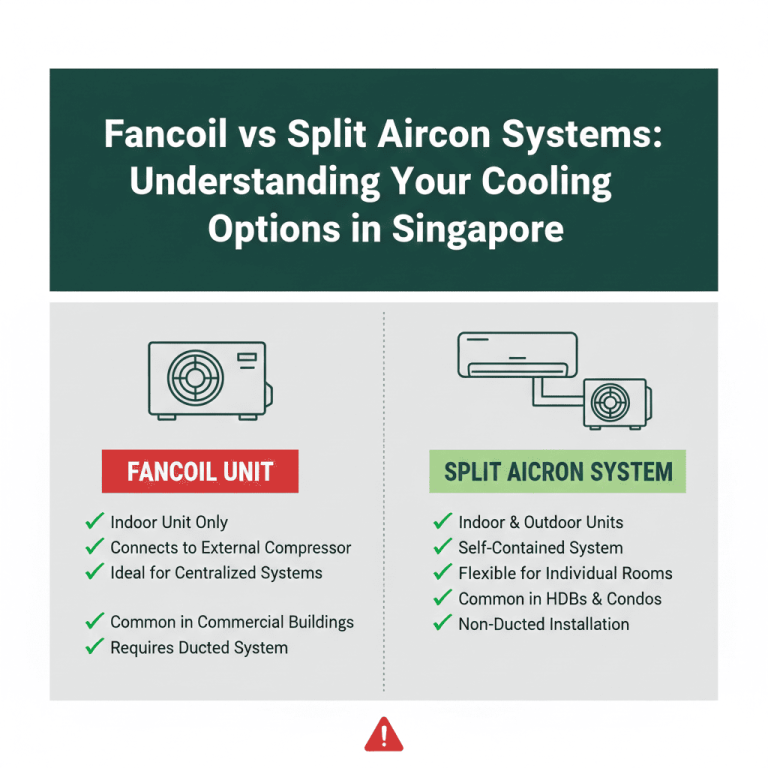
Choosing between aircon systems for your Singapore home involves understanding fundamental differences in how each technology operates. While wall-mounted split units dominate HDB flats and landed properties, many condominiums use fancoil units connected to centralised chilled water systems.
Each approach handles the same task removing heat through an aircon coil but the mechanics, costs, and maintenance requirements differ significantly.
This guide explains how both systems work, helping you understand why your cooling setup performs the way it does and what maintenance keeps it running efficiently.
How Aircon Coils Create Cooling
Every air conditioning system relies on heat exchange through coils. Understanding this process explains why coil maintenance matters so much for cooling performance.
The aircon cooling coil function:
The aircon cooling coil (evaporator coil) sits inside your indoor unit, hidden behind the air filter. When your aircon operates, cold refrigerant flows through this coil’s copper tubing.
Warm room air passes over the coil fins, transferring heat to the refrigerant inside. The now-cooled air returns to your room while the heat-laden refrigerant travels outside for release.
This heat exchange happens across thousands of thin aluminium fins attached to the aircon coil. These fins maximise surface area contact between air and refrigerant tubing. When dust accumulates on fins, it insulates them from airflow like wearing a jacket in summer.
Heat transfer efficiency drops, forcing your system to work harder for the same cooling result.
Dehumidification as a bonus:
Singapore’s humidity means your aircon cooling coil performs double duty. As warm, moisture-laden air contacts the cold coil surface, water vapour condenses into liquid similar to water droplets forming on a cold glass.
This condensation drips into a drain pan and exits through drainage pipes, reducing indoor humidity alongside temperature. Dirty coils compromise this dehumidification function, leaving rooms feeling clammy despite adequate cooling.
Fancoil Units: How Centralised Cooling Works
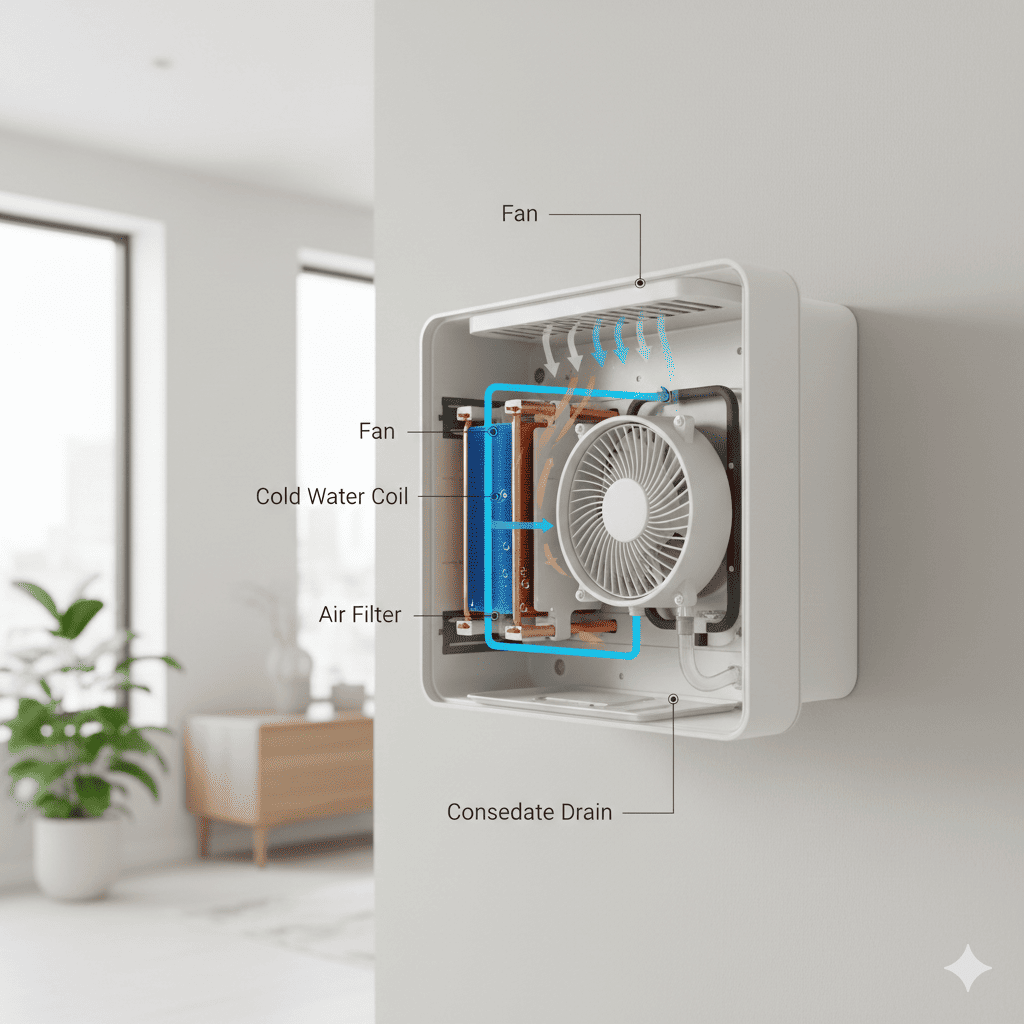
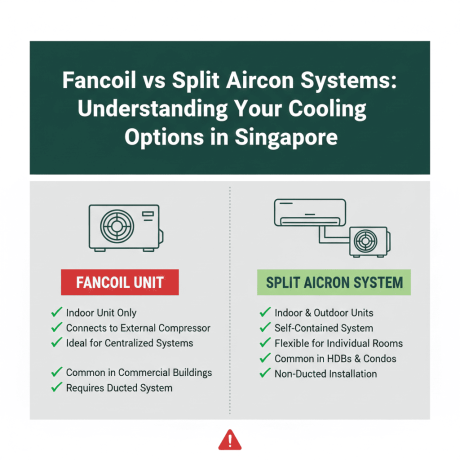
Fancoil units represent a different approach to residential cooling, commonly found in Singapore condominiums where building management provides centralised chilled water.
The fancoil mechanism:
A fancoil unit contains just two primary components: a fan and a coil. Unlike split aircon systems that contain refrigerant, fancoil coils circulate chilled water supplied from a central plant room. The building’s industrial chillers cool water to approximately 7°C, then pump it through insulated pipes to individual units throughout the building.
Inside your apartment, the fancoil draws room air across its water-filled coil. Heat transfers from the air to the chilled water, which then returns to the central plant for re-cooling. The process repeats continuously while your unit operates.
Advantages of fancoil systems:
Simpler maintenance: Without refrigerant, compressors, or outdoor units, fancoil units have fewer components requiring attention. The fan motor and coil represent the primary maintenance points.
Quieter operation: All major mechanical equipment chillers, pumps, cooling towers sits in the building’s plant room, far from residential areas. Your fancoil produces only fan noise, typically quieter than split system indoor units.
Space efficiency: No outdoor condenser unit means no balcony space consumption. This particularly benefits compact apartments where every square metre matters.
Limitations to consider:
No individual control over system: You cannot adjust cooling capacity beyond your thermostat settings. If the central system operates at reduced capacity (common during off-peak hours), your cooling suffers regardless of your preferences.
Dependency on building management: System failures affect entire buildings or sections, not just individual units. You cannot independently upgrade or replace your cooling system.
Metered billing complexity: Chilled water consumption charges vary between developments. Some use BTU meters measuring actual cooling consumed; others estimate based on unit size or runtime hours.
Split Aircon Systems: Independent Cooling Control
Wall-mounted split units represent the most common aircon systems in Singapore homes, offering complete independence from building infrastructure.
How split systems differ:
Split aircon systems contain refrigerant that cycles between indoor and outdoor units. Your indoor unit houses the evaporator aircon coil where room air cools. The outdoor unit contains the condenser coil where absorbed heat releases to outside air, plus the compressor that circulates refrigerant throughout the system.
Key advantages:
Complete control: You determine when your aircon operates, at what temperature, and can upgrade or replace units independently. Multi-split systems allow different temperatures in different rooms.
Proven reliability: Millions of split systems operate across Singapore, creating extensive technician expertise and readily available replacement parts.
Efficiency improvements: Modern inverter split systems adjust compressor speed based on cooling demand, reducing electricity consumption by 30-50% compared to older fixed-speed units.
Considerations:
More maintenance points: Both indoor and outdoor units require attention. The outdoor condenser aircon coil collects environmental debris dust, leaves, construction particles requiring periodic cleaning for optimal heat release.
Installation requirements: Wall penetrations for refrigerant pipes, drainage, and electrical connections. Outdoor unit placement requires adequate airflow clearance and structural support.
Maintaining Your Aircon Coil for Peak Performance
Regardless of system type, aircon coil cleanliness determines cooling efficiency.
For split system owners:
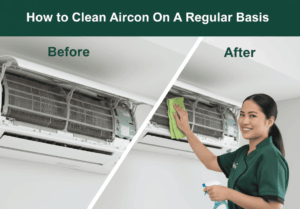
The aircon cooling coil requires professional cleaning every 6-12 months. Chemical wash services dissolve accumulated grime that regular filter cleaning cannot address. Between professional services, monthly filter cleaning prevents excessive coil contamination.
Outdoor condenser coils need attention too. Blocked fins restrict heat release, forcing compressors to work harder and increasing electricity consumption. Annual condenser cleaning maintains system efficiency.
For fancoil residents:
Building management typically handles fancoil maintenance as part of common charges confirm this arrangement with your management office.
However, you remain responsible for filter cleaning. Monthly filter maintenance prevents dust accumulation on coils between scheduled professional servicing.
Making the Right Choice
For new property purchases, understanding your aircon systems options helps evaluate different developments.
Fancoil condominiums offer quieter operation and reduced maintenance responsibility but sacrifice individual control. Split system properties provide independence but require more active maintenance involvement.
For existing homes, Helpling’s aircon services cover both system types with comprehensive maintenance ensuring optimal aircon coil performance year-round. Our technicians assess your specific setup and recommend appropriate servicing schedules for Singapore’s demanding climate.
How Helpling Services and Repairs Your FCU Aircon
Concealed ceiling units hide their own problems. By the time you notice weak cooling or a water stain spreading across the ceiling board, the filter, coil or condensate drain has usually been neglected for a while. Helpling’s aircon technicians service fan coil units, ducted installations and conventional split systems alike.
Our AC Diagnostic Service traces the cause of weak cooling, leaks or noise before any work starts. Routine servicing covers filter cleaning, coil vacuuming and drainage checks, while an aircon chemical wash or chemical overhaul restores heat exchange where buildup has hardened the usual fix for an FCU that no longer cools properly.
Every technician completes 200+ hours of professional training, works to transparent pricing with no hard selling, and every job carries a 30-day workmanship guarantee backed by 4.8/5 from 7,800+ Google reviews and over 100,000 happy customers.
Book your FCU aircon servicing with Helpling today.