
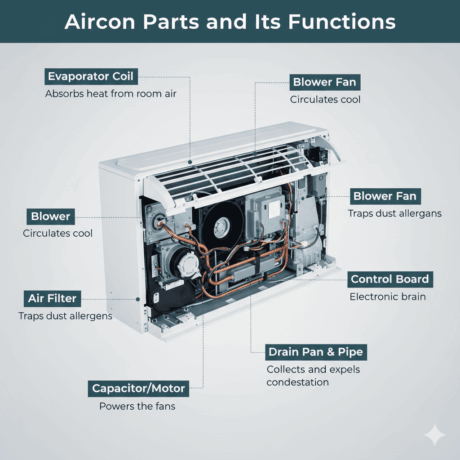

Understanding your air conditioner’s components isn’t just for technicians. When you know what each part does, you can spot problems early, communicate effectively with service professionals, and save money on unnecessary repairs.
Have you ever wondered why your aircon suddenly stopped cooling or started leaking water? Most issues stem from specific parts failing. Knowing which component does what helps you identify problems quickly and determine whether it’s a DIY fix or requires professional help.
In Singapore’s hot and humid climate, our air conditioners work harder than most, making maintenance crucial. Let’s explore the essential parts that keep your unit running smoothly.
The Basic Principle of Air Conditioner
Before diving into individual parts, understand that your aircon doesn’t “create” cold air, it removes heat from your room and transfers it outside.
The process involves refrigerant, a special liquid that cycles between your indoor and outdoor units. As warm air passes over the cold indoor coil, refrigerant absorbs the heat. This warm refrigerant travels to the outdoor unit where it’s compressed and releases the heat outside through the condenser coil.
This continuous cycle of absorbing and releasing heat keeps your room cool. Every part plays a specific role in making this process efficient.
Here’s the most important parts of aircon that you need to know.
Indoor Unit
Aircon indoor unit consists of:
Evaporator Coil
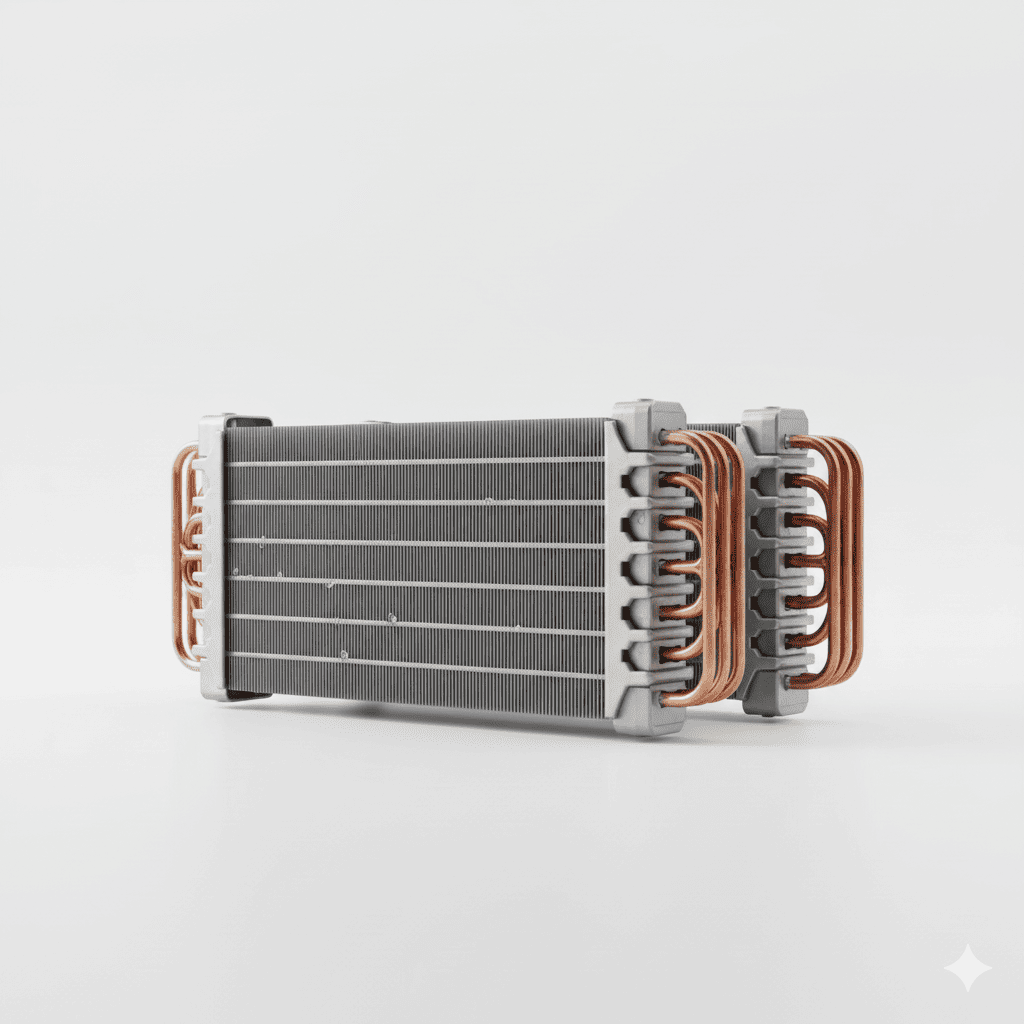
Evaporator coil is one of the aircon parts located inside the unit. It absorbs heat from the warm air in your room as refrigerant flows through it. This is where the actual cooling happens, warm air passes over the cold coil and returns to your room as cool air.
Printed Circuit Board (PCB)
The PCB is the brain of air conditioner, controlling all its functions and operations. It receives signals from your remote control and coordinates when the aircon turns on, off, or switches between modes.
Thermistor
The thermistor measures the room temperature and sends this information to the PCB. This sensor helps your aircon maintain your desired temperature by detecting when to cool more or less.
Capacitor
The capacitor stores electrical energy and provides the power boost needed to start the compressor and fan motors. Without it, your aircon wouldn’t have enough power to start up properly.

Blower Fan
The blower fan circulates air throughout your room by drawing warm air in and pushing cool air out. It ensures even cooling and continuous airflow across the evaporator coil.
Blower Motor
The blower motor powers the blower fan, controlling its speed based on your selected settings. It adjusts the airflow strength according to which mode you’re using.
Air Filter
The air filter traps dust, allergens, and particles from the air before it passes through the aircon system. Regular cleaning keeps your air quality high and prevents dirt from clogging internal components.
Drain Pain
The drain pan collects condensation water that forms on the cold evaporator coil. It channels this water to the drain pipe, preventing leaks inside your room.
Outdoor Unit of Air Conditioner
Aircon outdoor unit consists of:
Compressor
The compressor pressurizes the refrigerant and pumps it through the entire cooling system. It’s often called the “heart” of the aircon because it keeps the refrigerant circulating between indoor and outdoor units.
Condenser Coil
The condenser coil releases the heat absorbed from your room to the outside air. As hot refrigerant passes through this coil, it cools down and turns back into liquid form.
Expansion Valve
The expansion valve controls the flow of refrigerant into the evaporator coil and reduces its pressure. This pressure drop allows the refrigerant to evaporate and absorb heat efficiently.
Aircon Bracket
The aircon bracket securely mounts and supports the outdoor unit on your wall or platform. It must be strong enough to hold the unit’s weight and withstand Singapore’s weather conditions.
Aircon Piping
Aircon piping connects the indoor and outdoor units, allowing refrigerant to flow between them. These copper pipes form the closed loop that makes the cooling cycle possible.
Drain Pipe
The drain pipe carries condensation water from the indoor drain pan to the outside. Proper drainage prevents water from backing up and leaking into your room.
Aircon Insulation
Aircon insulation wraps around the refrigerant pipes to prevent heat gain and energy loss. It also stops condensation from forming on the cold pipes, which could cause water dripping.
Aircon Vent
The aircon vent directs the cooled air into your room at the right angle and spread. Adjustable vents help distribute air evenly throughout the space for consistent cooling.
Isolator Switch
The isolator switch allows you to safely cut off power to the aircon during maintenance or emergencies. It’s a safety feature that protects both the unit and the technician during servicing.
How Indoor and Outdoor Units of Aircon Work Together
The indoor and outdoor units of your air conditioner are like two halves of a complete system neither can function without the other.
They’re connected by refrigerant piping and electrical wiring that allow them to communicate and work in perfect harmony. When you turn on your aircon, the indoor unit’s evaporator coil absorbs heat from your room while the refrigerant inside evaporates.
This warm refrigerant then travels through the insulated pipes to the outdoor unit, where the compressor pressurizes it and the condenser coil releases the absorbed heat into the outside air.
Meanwhile, the PCB in the indoor unit constantly communicates with the outdoor unit, adjusting the compressor speed and fan operation based on the room temperature detected by the thermistor.
This continuous cycle happens seamlessly within seconds. As the refrigerant releases heat outside and cools down, it flows back through the piping to the indoor unit via the expansion valve, which reduces its pressure and temperature.
The now-cold refrigerant enters the evaporator coil again, ready to absorb more heat from your room. Throughout this process, condensation forms on the cold evaporator coil, which drips into the drain pan and flows out through the drain pipe.
Every component from the blower fan circulating air inside to the compressor pumping refrigerant outside must work together flawlessly. If any single part in either unit fails, the entire cooling cycle stops, which is why regular maintenance of both units is essential for optimal performance.
To make sure everything is done properly, you can consider a regular aircon check and service with a professional aircon servicing company.
What Are The Four Major Components In An Air Conditioning System?
Every air conditioning system relies on four essential components that work together to create the cooling cycle. These core parts are the evaporator coil, compressor, condenser coil, and expansion valve each playing a critical role in transferring heat from inside your room to the outside.
The evaporator coil, located in the indoor unit, absorbs heat from your room air.
The compressor, found in the outdoor unit, pressurizes the refrigerant and pumps it through the system.
The condenser coil, also in the outdoor unit, releases the absorbed heat to the outside air, so cleaning the condenser coil regularly is what keeps that heat transfer efficient.
Finally, the expansion valve regulates refrigerant flow and reduces its pressure before it enters the evaporator coil again.
Think of these four components as the heart of your air conditioning system. While other parts like fans, filters, and control boards are important for operation and comfort, these four major components are what actually make cooling possible.
Without any one of them, your aircon cannot complete the refrigeration cycle, and cooling stops entirely.
Understanding these key components helps you grasp why certain repairs are more expensive replacing or repairing these major parts requires specialized knowledge and directly impacts your aircon’s cooling capability.
Final Thoughts
An air conditioner is a complex machine with many different parts. It is important to know the aircon parts and their functions in order to keep your air conditioner running smoothly. Following these aircon maintenance tips will help you extend the life of your air conditioner and save money on repairs.
About Helpling
Helpling is a super app for household services. As a home service company, we work with, and train cleaning professionals to provide a wide range of services such as home cleaning service, aircon service, carpet cleaning, and mattress cleaning.
Beyond that, we also provide solutions for other household needs such as handyman, plumbing, and gardening service, all of which can be seamlessly and efficiently booked through our app or, for existing customers, via their personal Home Advisors.
Helpling’s professional cleaners are top-rated, thoughtful and thorough which give you the confidence and assurance you need so that you can focus on your priorities.
Helpling – A world of household services, just one click away.
New to Helpling? Book now to enjoy $20 off your first clean!
Follow Helpling’s social media channels such as Facebook and Instagram for more content and tips.